Every problem in the chapter beside the book’s answer, a chapter at a time as you scroll.

Chapter 10: Liquids and Solids

72 problems · 11 figures

Example 10.1 §10.1 source ↗

Order the following hydrocarbons from lowest to highest boiling point: C2H6, C3H8, and C4H10.

Answer

C2H6 < C3H8 < C4H10. All of these compounds are nonpolar and only have London dispersion forces: the larger the molecule, the larger the dispersion forces and the higher the boiling point. The ordering from lowest to highest boiling point is therefore C2H6 < C3H8 < C4H10.

Example 10.2 §10.1 source ↗

Predict which will have the higher boiling point: ICl or Br2. Explain your reasoning.

Answer

ICl. ICl and Br2 have similar masses (~160 amu) and therefore experience similar London dispersion forces. ICl is polar and thus also exhibits dipole-dipole attractions; Br2 is nonpolar and does not. The relatively stronger dipole-dipole attractions require more energy to overcome, so ICl will have the higher boiling point.

Example 10.3 §10.1 source ↗

Ethane (CH3CH3) has a melting point of −183 °C and a boiling point of −89 °C. Predict the melting and boiling points for methylamine (CH3NH2). Explain your reasoning.

Answer

The melting point and boiling point for methylamine are predicted to be significantly greater than those of ethane. CH3CH3 and CH3NH2 are similar in size and mass, but methylamine possesses an −NH group and therefore may exhibit hydrogen bonding. This greatly increases its IMFs, and therefore its melting and boiling points. It is difficult to predict values, but the known values are a melting point of −93 °C and a boiling point of −6 °C.

Example 10.4 §10.2 source ↗

Water rises in a glass capillary tube to a height of 8.4 cm. What is the diameter of the capillary tube?

Answer

diameter = 0.36 mm

Example 10.5 §10.3 source ↗

At 20 °C, the vapor pressures of several alcohols are given in this table. Explain these vapor pressures in terms of types and extents of IMFs for these alcohols:
Compound methanol CH3OH ethanol C2H5OH propanol C3H7OH butanol C4H9OH
Vapor Pressure at 20 °C 11.9 kPa 5.95 kPa 2.67 kPa 0.56 kPa

Answer

All these compounds exhibit hydrogen bonding; these strong IMFs are difficult for the molecules to overcome, so the vapor pressures are relatively low. As the size of molecule increases from methanol to butanol, dispersion forces increase, which means that the vapor pressures decrease as observed:
Pmethanol > Pethanol > Ppropanol > Pbutanol.

Example 10.6 §10.3 source ↗

The boiling point of ethyl ether was measured to be 10 °C at a base camp on the slopes of Mount Everest. Use Figure 10.24 to determine the approximate atmospheric pressure at the camp.
Figure 10.24 in the book ↗
The boiling points of liquids are the temperatures at which their equilibrium vapor pressures equal the pressure of the surrounding atmosphere. Normal boiling points are those corresponding to a pressure of 1 atm (101.3 kPa.)

Answer

Approximately 40 kPa (0.4 atm)

Example 10.7 §10.3 source ↗

At 20.0 °C, the vapor pressure of ethanol is 5.95 kPa, and at 63.5 °C, its vapor pressure is 53.3 kPa. Use this information to estimate the enthalpy of vaporization for ethanol.

Answer

41,360 J/mol or 41.4 kJ/mol

Example 10.8 §10.3 source ↗

For acetone (CH3)2CO, the normal boiling point is 56.5 °C and the enthalpy of vaporization is 31.3 kJ/mol. What is the vapor pressure of acetone at 25.0 °C?

Answer

30.1 kPa

Example 10.9 §10.3 source ↗

How much heat is required to evaporate 100.0 g of liquid ammonia, NH3, at its boiling point if its enthalpy of vaporization is 4.8 kJ/mol?

Answer

28 kJ

Example 10.10 §10.3 source ↗

What is the total amount of heat released when 94.0 g water at 80.0 °C cools to form ice at −30.0 °C?

Answer

68.7 kJ

Example 10.11 §10.4 source ↗

What phase changes can water undergo as the temperature changes if the pressure is held at 0.3 kPa? If the pressure is held at 50 kPa?

Answer

At 0.3 kPa: s⟶g at −58 °C. At 50 kPa: s⟶l at 0 °C, l ⟶ g at 78 °C

Example 10.12 §10.4 source ↗

Identify the phase changes that carbon dioxide will undergo as its temperature is increased from −100 °C while holding its pressure constant at 1500 kPa. At 50 kPa. At what approximate temperatures do these phase changes occur?

Answer

at 1500 kPa: s⟶l at −55 °C, l⟶g at −10 °C;

at 50 kPa: s⟶g at −60 °C

Example 10.13 §10.4 source ↗

Ammonia can be liquefied by compression at room temperature; oxygen cannot be liquefied under these conditions. Why do the two gases exhibit different behavior?

Answer

The critical temperature of ammonia is 405.5 K, which is higher than room temperature. The critical temperature of oxygen is below room temperature; thus oxygen cannot be liquefied at room temperature.

Example 10.14 §10.6 source ↗

The edge length of the unit cell for nickel is 0.3524 nm. The density of Ni is 8.90 g/cm3. Does nickel crystallize in a simple cubic structure? Explain.

Answer

No. If Ni was simple cubic, its density would be given by:
1 Ni atom×1 mol Ni6.022×1023Ni atoms×58.693g1 mol Ni= 9.746×10⁻²³g
V= l3= (3.524×10⁻⁸cm)3= 4.376×10⁻²³cm3
Then the density of Ni would be = 9.746×10⁻²³g4.376×10−23cm3= 2.23 g/cm3
Since the actual density of Ni is not close to this, Ni does not form a simple cubic structure.

Example 10.15 §10.6 source ↗

Silver crystallizes in an FCC structure. The edge length of its unit cell is 409 pm.

(a) What is the atomic radius of Ag in this structure?

(b) Calculate the density of Ag.

Answer

(a) 144 pm; (b) 10.5 g/cm3

Example 10.16 §10.6 source ↗

Lithium selenide can be described as a closest-packed array of selenide ions with lithium ions in all of the tetrahedral holes. What it the formula of lithium selenide?

Answer

Li2Se

Example 10.17 §10.6 source ↗

The white pigment titanium oxide crystallizes with titanium ions in one-half of the octahedral holes in a closest-packed array of oxide ions. What is the formula of titanium oxide?

Answer

TiO2

Example 10.18 §10.6 source ↗

The edge length of the unit cell of KCl (NaCl-like structure, FCC) is 6.28 Å. Assuming anion-cation contact along the cell edge, calculate the radius of the potassium ion. The radius of the chloride ion is 1.82 Å.

Answer

The radius of the potassium ion is 1.33 Å.

Example 10.19 §10.6 source ↗

A crystal with spacing between planes equal to 0.394 nm diffracts X-rays with a wavelength of 0.147 nm. What is the angle for the first order diffraction?

Answer

10.8°

10-1 §10.1 source ↗

In terms of their bulk properties, how do liquids and solids differ? How are they similar?

Answer

Liquids and solids are similar in that they are matter composed of atoms, ions, or molecules. They are incompressible and have similar densities that are both much larger than those of gases. They are different in that liquids have no fixed shape, and solids are rigid.

10-3 §10.1 source ↗

In terms of the kinetic molecular theory, in what ways are liquids similar to gases? In what ways are liquids different from gases?

Answer

They are similar in that the atoms or molecules are free to move from one position to another. They differ in that the particles of a liquid are confined to the shape of the vessel in which they are placed. In contrast, a gas will expand without limit to fill the space into which it is placed.

10-5 §10.1 source ↗

What is the evidence that all neutral atoms and molecules exert attractive forces on each other?

Answer

All atoms and molecules will condense into a liquid or solid in which the attractive forces exceed the kinetic energy of the molecules, at sufficiently low temperature.

10-7 §10.1 source ↗

Define the following and give an example of each:

(a) dispersion force

(b) dipole-dipole attraction

(c) hydrogen bond

Answer

(a) Dispersion forces occur as an atom develops a temporary dipole moment when its electrons are distributed asymmetrically about the nucleus. This structure is more prevalent in large atoms such as argon or radon. A second atom can then be distorted by the appearance of the dipole in the first atom. The electrons of the second atom are attracted toward the positive end of the first atom, which sets up a dipole in the second atom. The net result is rapidly fluctuating, temporary dipoles that attract one another (e.g., Ar). (b) A dipole-dipole attraction is a force that results from an electrostatic attraction of the positive end of one polar molecule for the negative end of another polar molecule (e.g., ICI molecules attract one another by dipole-dipole interaction). (c) Hydrogen bonds form whenever a hydrogen atom is bonded to one of the more electronegative atoms, such as a fluorine, oxygen, or nitrogen atom. The electrostatic attraction between the partially positive hydrogen atom in one molecule and the partially negative atom in another molecule gives rise to a strong dipole-dipole interaction called a hydrogen bond (e.g., HF⋯HF).

10-9 §10.1 source ↗

Why do the boiling points of the noble gases increase in the order He < Ne < Ar < Kr < Xe?

Answer

The London forces typically increase as the number of electrons increase.

10-11 §10.1 source ↗

Arrange each of the following sets of compounds in order of increasing boiling point temperature:

(a) HCl, H2O, SiH4

(b) F2, Cl2, Br2

(c) CH4, C2H6, C3H8

(d) O2, NO, N2

Answer

(a) SiH4 < HCl < H2O; (b) F2 < Cl2 < Br2; (c) CH4 < C2H6 < C3H8; (d) N2 < O2 < NO

10-13 §10.1 source ↗

On the basis of intermolecular attractions, explain the differences in the boiling points of n–butane (−1 °C) and chloroethane (12 °C), which have similar molar masses.

Answer

Only rather small dipole-dipole interactions from C-H bonds are available to hold n-butane in the liquid state. Chloroethane, however, has rather large dipole interactions because of the Cl-C bond; the interaction, therefore, is stronger, leading to a higher boiling point.

10-15 §10.1 source ↗

The melting point of H2O(s) is 0 °C. Would you expect the melting point of H2S(s) to be −85 °C, 0 °C, or 185 °C? Explain your answer.

Answer

−85 °C. Water has stronger hydrogen bonds, so it melts at a higher temperature.

10-17 §10.1 source ↗

Explain why a hydrogen bond between two water molecules is weaker than a hydrogen bond between two hydrogen fluoride molecules.

Answer

The hydrogen bond between two hydrogen fluoride molecules is stronger than that between two water molecules because the electronegativity of F is greater than that of O. Consequently, the partial negative charge on F is greater than that on O. The hydrogen bond between the partially positive H and the larger partially negative F will be stronger than that formed between H and O.

10-19 §10.1 source ↗

Proteins are chains of amino acids that can form in a variety of arrangements, one of which is a helix. What kind of IMF is responsible for holding the protein strand in this shape? On the protein image, show the locations of the IMFs that hold the protein together:
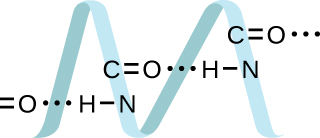
Two turns of a helical structure are shown horizontally. Three Lewis structures are superimposed on the helix. The first shows horizontally stacked dashes next to an oxygen atom, with three dots connecting to a hydrogen atom, and a single dash connecting the hydrogen atom to a nitrogen atom. The second shows a carbon atom double bonded to an oxygen atom, then three dots connecting to a hydrogen atom which is bonded to a nitrogen atom. The third shows a carbon atom double bonded to an oxygen atom with three dots extending to the right of the oxygen atom.

Answer

H-bonding is the principle IMF holding the protein strands together. The H-bonding is between the N−H and C=O.

10-21 §10.1 source ↗

Identify the intermolecular forces present in the following solids:

(a) CH3CH2OH

(b) CH3CH2CH3

(c) CH3CH2Cl

Answer

(a) hydrogen bonding, dipole-dipole attraction, and dispersion forces; (b) dispersion forces; (c) dipole-dipole attraction and dispersion forces

10-23 §10.2 source ↗

Although steel is denser than water, a steel needle or paper clip placed carefully lengthwise on the surface of still water can be made to float. Explain at a molecular level how this is possible.
Figure 10.67 in the book ↗
(credit: Cory Zanker)

Answer

The water molecules have strong intermolecular forces of hydrogen bonding. The water molecules are thus attracted strongly to one another and exhibit a relatively large surface tension, forming a type of “skin” at its surface. This skin can support a bug or paper clip if gently placed on the water.

10-25 §10.2 source ↗

You may have heard someone use the figure of speech “slower than molasses in winter” to describe a process that occurs slowly. Explain why this is an apt idiom, using concepts of molecular size and shape, molecular interactions, and the effect of changing temperature.

Answer

Temperature has an effect on intermolecular forces: The higher the temperature, the greater the kinetic energies of the molecules and the greater the extent to which their intermolecular forces are overcome, and so the more fluid (less viscous) the liquid. The lower the temperature, the less the intermolecular forces are overcome, and so the less viscous the liquid.

10-27 §10.2 source ↗

The surface tension and viscosity of water at several different temperatures are given in this table.

Water Surface Tension (mN/m) Viscosity (mPa s)
0 °C 75.6 1.79
20 °C 72.8 1.00
60 °C 66.2 0.47
100 °C 58.9 0.28

(a) As temperature increases, what happens to the surface tension of water? Explain why this occurs, in terms of molecular interactions and the effect of changing temperature.

(b) As temperature increases, what happens to the viscosity of water? Explain why this occurs, in terms of molecular interactions and the effect of changing temperature.

Answer

(a) As the water reaches higher temperatures, the increased kinetic energies of its molecules are more effective in overcoming hydrogen bonding, and so its surface tension decreases. Surface tension and intermolecular forces are directly related. (b) The same trend in viscosity is seen as in surface tension, and for the same reason.

10-29 §10.2 source ↗

Water rises in a glass capillary tube to a height of 17 cm. What is the diameter of the capillary tube?

Answer

1.7 × 10⁻⁴ m

10-31 §10.3 source ↗

Heat is added to ice at 0 °C. Explain why the temperature of the ice does not change. What does change?

Answer

The heat is absorbed by the ice, providing the energy required to partially overcome intermolecular attractive forces in the solid and causing a phase transition to liquid water. The solution remains at 0 °C until all the ice is melted. Only the amount of water existing as ice changes until the ice disappears. Then the temperature of the water can rise.

10-33 §10.3 source ↗

Identify two common observations indicating some liquids have sufficient vapor pressures to noticeably evaporate?

Answer

We can see the amount of liquid in an open container decrease and we can smell the vapor of some liquids.

10-35 §10.3 source ↗

What is the relationship between the intermolecular forces in a liquid and its vapor pressure?

Answer

The vapor pressure of a liquid decreases as the strength of its intermolecular forces increases.

10-37 §10.3 source ↗

Why does spilled gasoline evaporate more rapidly on a hot day than on a cold day?

Answer

As the temperature increases, the average kinetic energy of the molecules of gasoline increases and so a greater fraction of molecules have sufficient energy to escape from the liquid than at lower temperatures.

10-39 §10.3 source ↗

When is the boiling point of a liquid equal to its normal boiling point?

Answer

They are equal when the pressure of gas above the liquid is exactly 1 atm.

10-41 §10.3 source ↗

Use the information in Figure 10.24 to estimate the boiling point of water in Denver when the atmospheric pressure is 83.3 kPa.
Figure 10.24 in the book ↗
The boiling points of liquids are the temperatures at which their equilibrium vapor pressures equal the pressure of the surrounding atmosphere. Normal boiling points are those corresponding to a pressure of 1 atm (101.3 kPa.)

Answer

approximately 95 °C

10-43 §10.3 source ↗

Explain the following observations:

(a) It takes longer to cook an egg in Ft. Davis, Texas (altitude, 5000 feet above sea level) than it does in Boston (at sea level).

(b) Perspiring is a mechanism for cooling the body.

Answer

(a) At 5000 feet, the atmospheric pressure is lower than at sea level, and water will therefore boil at a lower temperature. This lower temperature will cause the physical and chemical changes involved in cooking the egg to proceed more slowly, and a longer time is required to fully cook the egg. (b) As long as the air surrounding the body contains less water vapor than the maximum that air can hold at that temperature, perspiration will evaporate, thereby cooling the body by removing the heat of vaporization required to vaporize the water.

10-45 §10.3 source ↗

Explain why the molar enthalpies of vaporization of the following substances increase in the order CH4 < C2H6 < C3H8, even though the type of IMF (dispersion) is the same.

Answer

Dispersion forces increase with molecular mass or size. As the number of atoms composing the molecules in this homologous series increases, so does the extent of intermolecular attraction via dispersion forces and, consequently, the energy required to overcome these forces and vaporize the liquids.

10-47 §10.3 source ↗

The enthalpy of vaporization of CO2(l) is 9.8 kJ/mol. Would you expect the enthalpy of vaporization of CS2(l) to be 28 kJ/mol, 9.8 kJ/mol, or −8.4 kJ/mol? Discuss the plausibility of each of these answers.

Answer

The boiling point of CS2 is higher than that of CO2 partially because of the higher molecular weight of CS2; consequently, the attractive forces are stronger in CS2. It would be expected, therefore, that the heat of vaporization would be greater than that of 9.8 kJ/mol for CO2. A value of 28 kJ/mol would seem reasonable. A value of −8.4 kJ/mol would indicate a release of energy upon vaporization, which is clearly implausible.

10-49 §10.3 source ↗

Ethyl chloride (boiling point, 13 °C) is used as a local anesthetic. When the liquid is sprayed on the skin, it cools the skin enough to freeze and numb it. Explain the cooling effect of liquid ethyl chloride.

Answer

The thermal energy (heat) needed to evaporate the liquid is removed from the skin.

10-51 §10.3 source ↗

How much heat is required to convert 422 g of liquid H2O at 23.5 °C into steam at 150 °C?

Answer

1125 kJ

10-53 §10.3 source ↗

Titanium tetrachloride, TiCl4, has a melting point of −23.2 °C and has a ΔH fusion = 9.37 kJ/mol.

(a) How much energy is required to melt 263.1 g TiCl4?

(b) For TiCl4, which will likely have the larger magnitude: ΔH fusion or ΔH vaporization? Explain your reasoning.

Answer

(a) 13.0 kJ; (b) It is likely that the heat of vaporization will have a larger magnitude since in the case of vaporization the intermolecular interactions have to be completely overcome, while melting weakens or destroys only some of them.

10-55 §10.4 source ↗

What phase changes will take place when water is subjected to varying pressure at a constant temperature of 0.005 °C? At 40 °C? At −40 °C?

Answer

At low pressures and 0.005 °C, the water is a gas. As the pressure increases to 4.6 torr, the water becomes a solid; as the pressure increases still more, it becomes a liquid. At 40 °C, water at low pressure is a vapor; at pressures higher than about 75 torr, it converts into a liquid. At −40 °C, water goes from a gas to a solid as the pressure increases above very low values.

10-57 §10.4 source ↗

From the phase diagram for carbon dioxide in Figure 10.34, determine the state of CO2 at:

(a) 20 °C and 1000 kPa

(b) 10 °C and 2000 kPa

(c) 10 °C and 100 kPa

(d) −40 °C and 500 kPa

(e) −80 °C and 1500 kPa

(f) −80 °C and 10 kPa

Figure 10.34 in the book ↗
A phase diagram for carbon dioxide is shown. The pressure axis is plotted on a logarithmic scale to accommodate the large range of values.

Answer

(a) gas; (b) gas; (c) gas; (d) gas; (e) solid; (f) gas

10-59 §10.4 source ↗

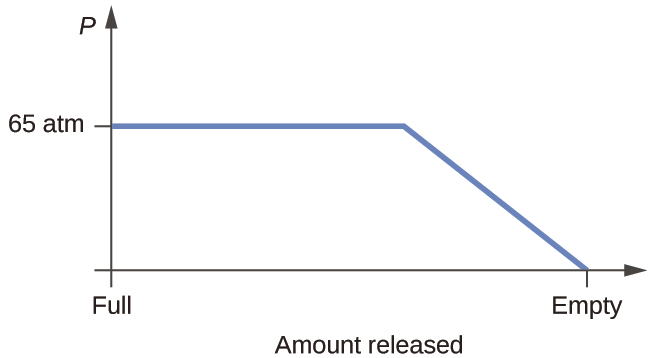
Consider a cylinder containing a mixture of liquid carbon dioxide in equilibrium with gaseous carbon dioxide at an initial pressure of 65 atm and a temperature of 20 °C. Sketch a plot depicting the change in the cylinder pressure with time as gaseous carbon dioxide is released at constant temperature.

Answer


An x-axis is labeled at the left as “Full” and at the right as “Empty.” A y-axis is labeled at the top as “P.” Beneath the x-axis is the label “Amount released.” A horizontal line that then slopes downward is drawn about halfway up the vertical line and labeled on the left as “65 a t m.” About two-thirds of the way across the x-axis, it slopes downward in a straight line to meet the “empty” label on the bottom right of the axis.

10-61 §10.4 source ↗

If a severe storm results in the loss of electricity, it may be necessary to use a clothesline to dry laundry. In many parts of the country in the dead of winter, the clothes will quickly freeze when they are hung on the line. If it does not snow, will they dry anyway? Explain your answer.

Answer

Yes, ice will sublime, although it may take it several days. Ice has a small vapor pressure, and some ice molecules form gas and escape from the ice crystals. As time passes, more and more solid converts to gas until eventually the clothes are dry.

10-63 §10.4 source ↗

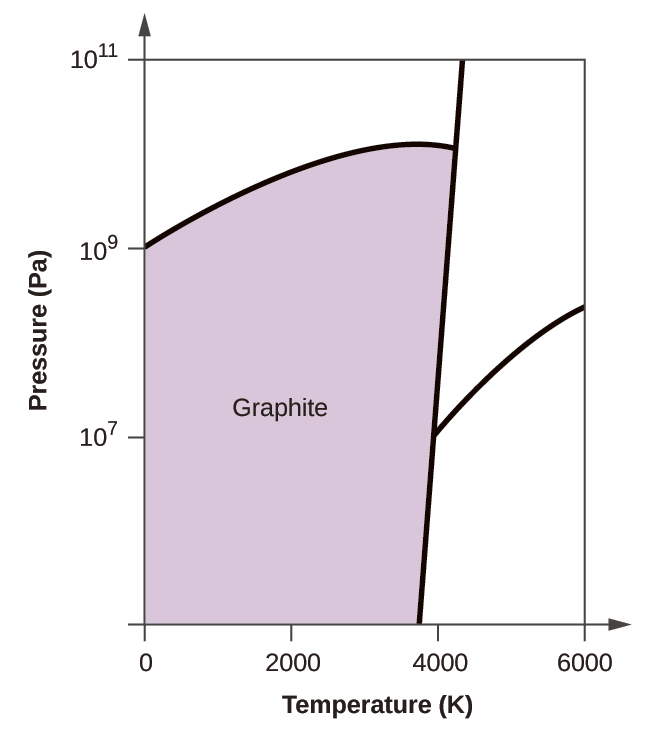
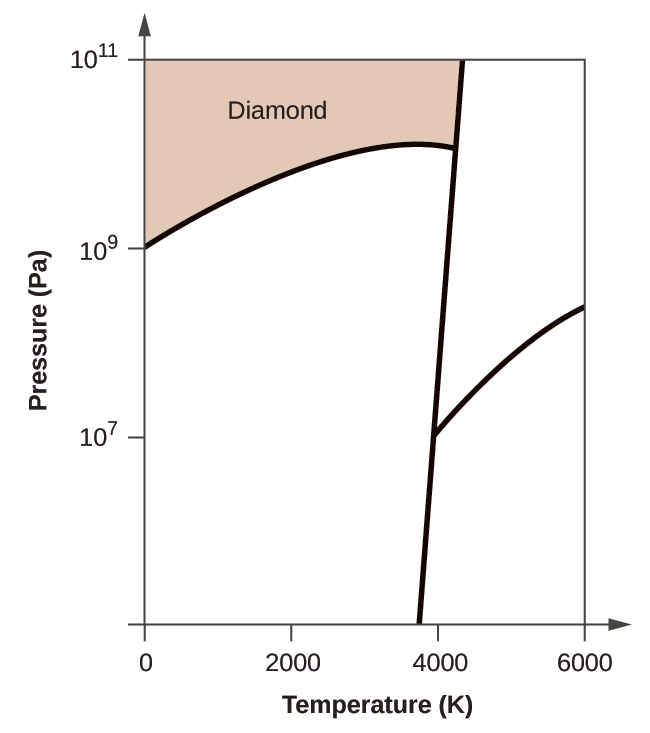
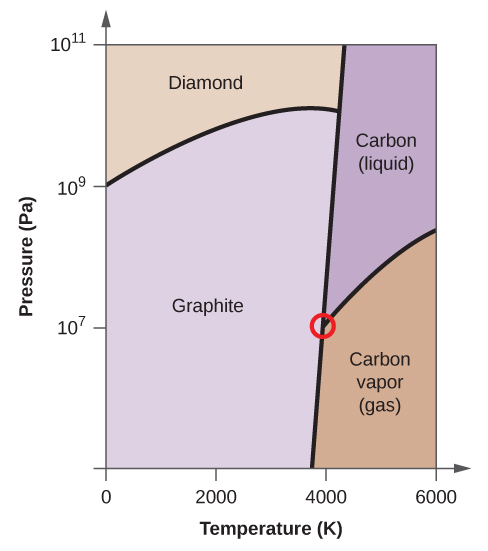
Elemental carbon has one gas phase, one liquid phase, and two different solid phases, as shown in the phase diagram:
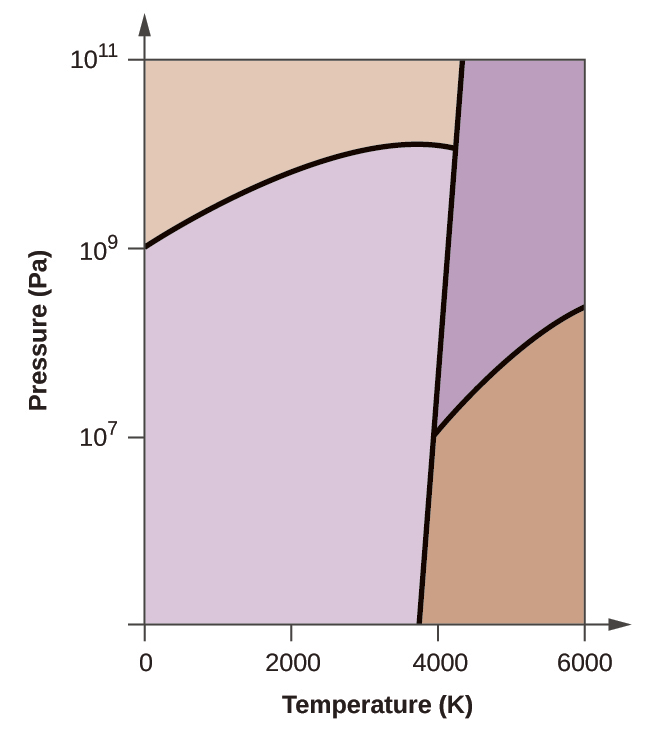
This figure shows an x-axis that is labeled, “Temperature ( K ),” and a y-axis labeled, “Pressure ( P a ).” The x-axis is marked off in increments of 2000 starting from 0. The y-axis is marked off at 0, 10 to the 7, ten to the 9, and ten to the 11. There is a slightly negatively sloped line that passes through the x-axis at about 3800. From this line there is a line that curves up and then down to the left to pass through the y-axis at ten to the 9. There is another line that goes up and to the right.

(a) On the phase diagram, label the gas and liquid regions.

(b) Graphite is the most stable phase of carbon at normal conditions. On the phase diagram, label the graphite phase.

(c) If graphite at normal conditions is heated to 2500 K while the pressure is increased to 1010 Pa, it is converted into diamond. Label the diamond phase.

(d) Circle each triple point on the phase diagram.

(e) In what phase does carbon exist at 5000 K and 108 Pa?

(f) If the temperature of a sample of carbon increases from 3000 K to 5000 K at a constant pressure of 106 Pa, which phase transition occurs, if any?

Answer

(a)
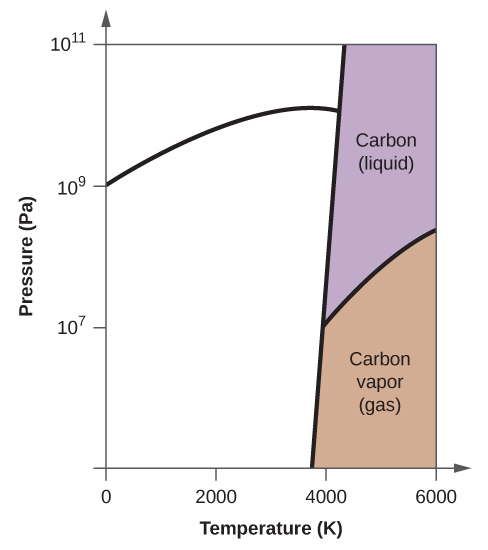
This figure shows an x-axis that is labeled, “Temperature ( K ),” and a y-axis labeled, “Pressure ( P a ).” The x-axis is marked off in increments of 2000 starting from 0. The y-axis is marked off at 0, 10 to the 7, ten to the 9, and ten to the 11. There is a slightly negatively sloped line that passes through the x-axis at about 3800. From this line there is a line that curves up and then down to the left to pass through the y-axis at ten to the 9. There is another line that goes up and to the right. The two quadrants to the right are labeled, “Water ( liquid )” and “Water vapor ( gas ).”


(b)

This figure shows an x-axis that is labeled, “Temperature ( K ),” and a y-axis labeled, “Pressure ( P a ).” The x-axis is marked off in increments of 2000 starting from 0. The y-axis is marked off at 0, 10 to the 7, ten to the 9, and ten to the 11. There is a slightly negatively sloped line that passes through the x-axis at about 3800. From this line there is a line that curves up and then down to the left to pass through the y-axis at ten to the 9. There is another line that goes up and to the right. The quadrant to the left is labeled, “Graphite.”


(c)

This figure shows an x-axis that is labeled, “Temperature ( K ),” and a y-axis labeled, “Pressure ( P a ).” The x-axis is marked off in increments of 2000 starting from 0. The y-axis is marked off at 0, 10 to the 7, ten to the 9, and ten to the 11. There is a slightly negatively sloped line that passes through the x-axis at about 3800. From this line there is a line that curves up and then down to the left to pass through the y-axis at ten to the 9. There is another line that goes up and to the right. The top quadrant is labeled, “Diamond.”


(d)

This figure shows an x-axis that is labeled, “Temperature ( K ),” and a y-axis labeled, “Pressure ( P a ).” The x-axis is marked off in increments of 2000 starting from 0. The y-axis is marked off at 0, 10 to the 7, ten to the 9, and ten to the 11. There is a slightly negatively sloped line that passes through the x-axis at about 3800. From this line there is a line that curves up and then down to the left to pass through the y-axis at ten to the 9. There is another line that goes up and to the right. The four quadrants are labeled, “Diamond” at the top, “Graphite”, to the left, “water ( liquid )” to the top right, and “water vapor ( gas ),” to the bottom right. There is a red circle where the liquid, gas, and graphite lines intersect.


(e) liquid phase (f) sublimation

10-65 §10.5 source ↗

At very low temperatures oxygen, O2, freezes and forms a crystalline solid. Which best describes these crystals?

(a) ionic

(b) covalent network

(c) metallic

(d) amorphous

(e) molecular crystals

Answer

(e) molecular crystals

10-67 §10.5 source ↗

Explain why ice, which is a crystalline solid, has a melting temperature of 0 °C, whereas butter, which is an amorphous solid, softens over a range of temperatures.

Answer

Ice has a crystalline structure stabilized by hydrogen bonding. These intermolecular forces are of comparable strength and thus require the same amount of energy to overcome. As a result, ice melts at a single temperature and not over a range of temperatures. The various, very large molecules that compose butter experience varied van der Waals attractions of various strengths that are overcome at various temperatures, and so the melting process occurs over a wide temperature range.

10-69 §10.5 source ↗

Identify the type of crystalline solid (metallic, network covalent, ionic, or molecular) formed by each of the following substances:

(a) CaCl2

(b) SiC

(c) N2

(d) Fe

(e) C (graphite)

(f) CH3CH2CH2CH3

(g) HCl

(h) NH4NO3

(i) K3PO4

Answer

(a) ionic; (b) covalent network; (c) molecular; (d) metallic; (e) covalent network; (f) molecular; (g) molecular; (h) ionic; (i) ionic

10-71 §10.5 source ↗

Classify each substance in the table as either a metallic, ionic, molecular, or covalent network solid:

Substance Appearance Melting Point Electrical Conductivity Solubility in Water
X brittle, white 800 °C only if melted/dissolved soluble
Y shiny, malleable 1100 °C high insoluble
Z hard, colorless 3550 °C none insoluble

Answer

X = ionic; Y = metallic; Z = covalent network

10-73 §10.5 source ↗

Substance A is shiny, conducts electricity well, and melts at 975 °C. Substance A is likely a(n):

(a) ionic solid

(b) metallic solid

(c) molecular solid

(d) covalent network solid

Answer

(b) metallic solid

10-75 §10.6 source ↗

Describe the crystal structure of iron, which crystallizes with two equivalent metal atoms in a cubic unit cell.

Answer

The structure of this low-temperature form of iron (below 910 °C) is body-centered cubic. There is one-eighth atom at each of the eight corners of the cube and one atom in the center of the cube.

10-77 §10.6 source ↗

What is the coordination number of a chromium atom in the body-centered cubic structure of chromium?

Answer

eight

10-79 §10.6 source ↗

Cobalt metal crystallizes in a hexagonal closest packed structure. What is the coordination number of a cobalt atom?

Answer

12

10-81 §10.6 source ↗

Tungsten crystallizes in a body-centered cubic unit cell with an edge length of 3.165 Å.

(a) What is the atomic radius of tungsten in this structure?

(b) Calculate the density of tungsten.

Answer

(a) 1.370 Å; (b) 19.26 g/cm

10-83 §10.6 source ↗

Barium crystallizes in a body-centered cubic unit cell with an edge length of 5.025 Å

(a) What is the atomic radius of barium in this structure?

(b) Calculate the density of barium.

Answer

(a) 2.176 Å; (b) 3.595 g/cm3

10-85 §10.6 source ↗

The density of aluminum is 2.7 g/cm3; that of silicon is 2.3 g/cm3. Explain why Si has the lower density even though it has heavier atoms.

Answer

The crystal structure of Si shows that it is less tightly packed (coordination number 4) in the solid than Al (coordination number 12).

10-87 §10.6 source ↗

Cadmium sulfide, sometimes used as a yellow pigment by artists, crystallizes with cadmium, occupying one-half of the tetrahedral holes in a closest packed array of sulfide ions. What is the formula of cadmium sulfide? Explain your answer.

Answer

In a closest-packed array, two tetrahedral holes exist for each anion. If only half the tetrahedral holes are occupied, the numbers of anions and cations are equal. The formula for cadmium sulfide is CdS.

10-89 §10.6 source ↗

What is the formula of the magnetic oxide of cobalt, used in recording tapes, that crystallizes with cobalt atoms occupying one-eighth of the tetrahedral holes and one-half of the octahedral holes in a closely packed array of oxide ions?

Answer

Co3O4

10-91 §10.6 source ↗

A compound of thallium and iodine crystallizes in a simple cubic array of iodide ions with thallium ions in all of the cubic holes. What is the formula of this iodide? Explain your answer.

Answer

In a simple cubic array, only one cubic hole can be occupied be a cation for each anion in the array. The ratio of thallium to iodide must be 1:1; therefore, the formula for thallium is TlI.

10-93 §10.6 source ↗

What is the percent by mass of titanium in rutile, a mineral that contains titanium and oxygen, if structure can be described as a closest packed array of oxide ions with titanium ions in one-half of the octahedral holes? What is the oxidation number of titanium?

Answer

59.95%; The oxidation number of titanium is +4.

10-95 §10.6 source ↗

As minerals were formed from the molten magma, different ions occupied the same cites in the crystals. Lithium often occurs along with magnesium in minerals despite the difference in the charge on their ions. Suggest an explanation.

Answer

Both ions are close in size: Mg, 0.65; Li, 0.60. This similarity allows the two to interchange rather easily. The difference in charge is generally compensated by the switch of Si4+ for Al3+.

10-97 §10.6 source ↗

One of the various manganese oxides crystallizes with a cubic unit cell that contains manganese ions at the corners and in the center. Oxide ions are located at the center of each edge of the unit cell. What is the formula of the compound?

Answer

Mn2O3

10-99 §10.6 source ↗

At temperatures above ~175 °C, thallium(I) iodide crystallizes with the same structure as CsCl. The edge length of the unit cell of TlI is 4.20 Å. Assuming contact between the body-centered Tl+ ion and the cube-corner I− ions of a unit cell, calculate the ionic radius of TI+. (The ionic radius of I− is 2.16 Å.)

Answer

1.48 Å

10-101 §10.6 source ↗

What is the spacing between crystal planes that diffract X-rays with a wavelength of 1.541 Å at an angle θ of 15.55° (first order diffraction)?

Answer

2.874 Å

10-103 §10.6 source ↗

A metal with spacing between planes equal to 0.4164 nm diffracts X-rays with a wavelength of 0.2879 nm. What is the diffraction angle for the first order diffraction peak?

Answer

20.2°

10-105 §10.6 source ↗

When an electron in an excited molybdenum atom falls from the L to the K shell, an X-ray is emitted. These X-rays are diffracted at an angle of 7.75° by planes with a separation of 2.64 Å. What is the difference in energy between the K shell and the L shell in molybdenum assuming a first order diffraction?

Answer

1.74 × 10⁴ eV

Loading chapter 11…

Problems and answers are adapted from Chemistry: Atoms First 2e by Paul Flowers, Edward J. Neth, William R. Robinson, Klaus Theopold and Richard Langley, OpenStax, and are used under the CC BY-NC-SA 4.0 licence. Access for free at https://openstax.org/books/chemistry-atoms-first-2e/pages/1-introduction. Illustrations: Copyright Rice University, OpenStax, under CC BY-NC-SA 4.0 license. This adaptation is released under the same licence, is non-commercial, and is neither affiliated with nor endorsed by OpenStax or Rice University.