Every problem in the chapter beside the book’s answer, a chapter at a time as you scroll.
Chapter 8: Gases
76 problems · 13 figuresExample 8.1 §8.1 source ↗
Answer
Example 8.2 §8.1 source ↗
Answer
Example 8.3 §8.1 source ↗
(a) torr
(b) Pa
(c) bar
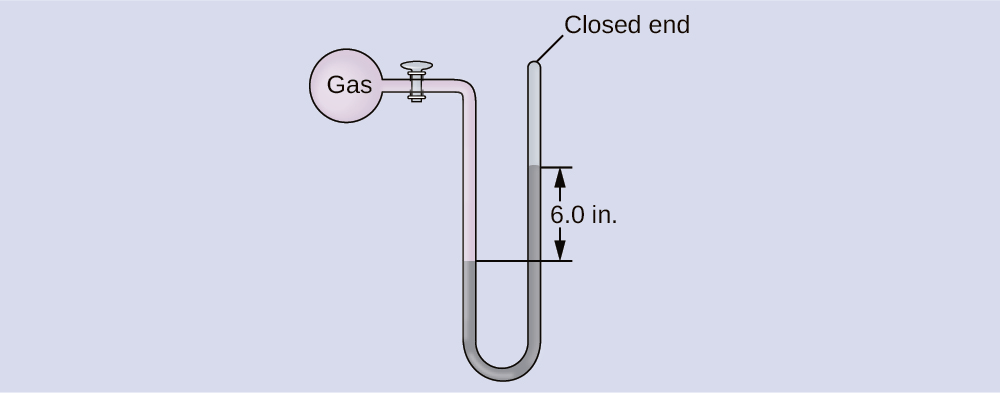
Answer
Example 8.4 §8.1 source ↗
(a) mm Hg
(b) atm
(c) kPa
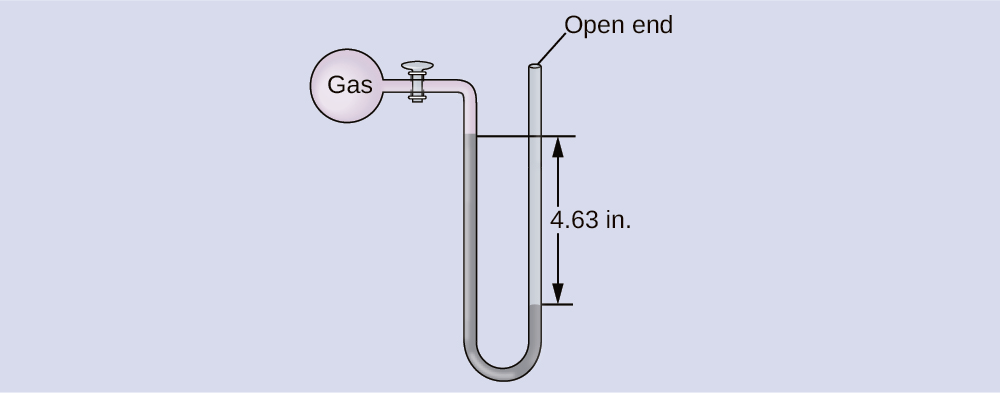
Answer
Example 8.5 §8.2 source ↗
Answer
Example 8.6 §8.2 source ↗
Answer
Example 8.7 §8.2 source ↗
Answer
Example 8.8 §8.2 source ↗
(a) the P-V graph in Figure 8.13
(b) the vs. V graph in Figure 8.13
(c) the Boyle’s law equation
Comment on the likely accuracy of each method.
Answer
Example 8.9 §8.2 source ↗
Answer
Example 8.10 §8.2 source ↗
Answer
Example 8.11 §8.3 source ↗
Answer
Example 8.12 §8.3 source ↗
Answer
Example 8.13 §8.3 source ↗
Answer
Example 8.14 §8.3 source ↗
Answer
Example 8.15 §8.3 source ↗
Answer
Example 8.16 §8.3 source ↗
Answer
Example 8.17 §8.3 source ↗
Answer
Example 8.18 §8.3 source ↗
Answer
Example 8.19 §8.3 source ↗
Answer
Example 8.20 §8.4 source ↗
Answer
Example 8.21 §8.4 source ↗
Answer
Example 8.22 §8.4 source ↗
Answer
Example 8.23 §8.5 source ↗
Answer
8-1 §8.1 source ↗
Answer
8-3 §8.1 source ↗
Answer
8-5 §8.1 source ↗
Answer
8-7 §8.1 source ↗
Answer
8-9 §8.1 source ↗
Answer
8-11 §8.1 source ↗
Consider this scenario and answer the following questions: On a mid-August day in the northeastern United States, the following information appeared in the local newspaper: atmospheric pressure at sea level 29.97 in. Hg, 1013.9 mbar.
(a) What was the pressure in kPa?
(b) The pressure near the seacoast in the northeastern United States is usually reported near 30.0 in. Hg. During a hurricane, the pressure may fall to near 28.0 in. Hg. Calculate the drop in pressure in torr.
Answer
8-13 §8.1 source ↗
The pressure of a sample of gas is measured at sea level with a closed-end manometer. The liquid in the manometer is mercury. Determine the pressure of the gas in:
(a) torr
(b) Pa
(c) bar
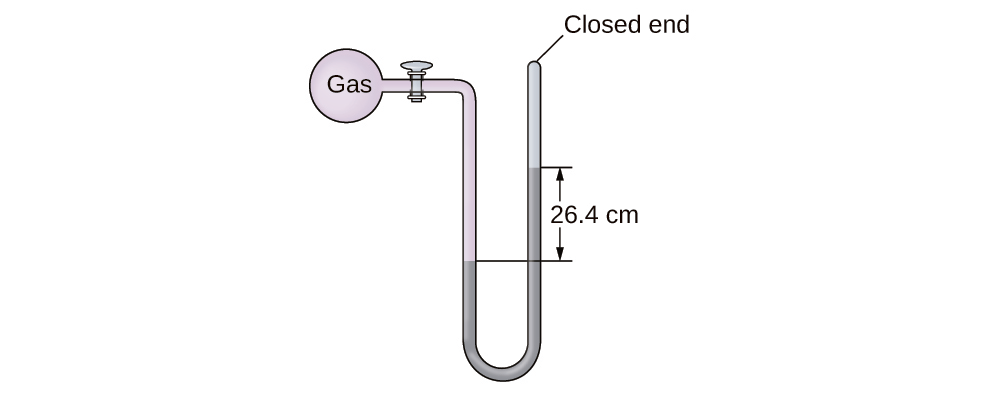
Answer
8-15 §8.1 source ↗
The pressure of a sample of gas is measured at sea level with an open-end mercury manometer. Assuming atmospheric pressure is 760.0 mm Hg, determine the pressure of the gas in:
(a) mm Hg
(b) atm
(c) kPa
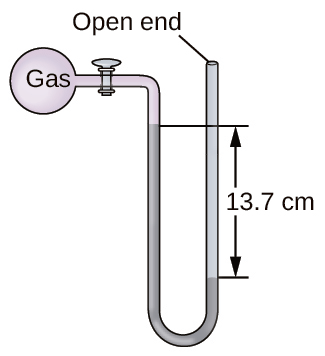
Answer
8-17 §8.1 source ↗
Answer
8-19 §8.2 source ↗
Answer
8-21 §8.2 source ↗
Answer
8-23 §8.2 source ↗
Answer
8-25 §8.2 source ↗
Answer
8-27 §8.2 source ↗
Answer
8-29 §8.2 source ↗
Answer
8-31 §8.2 source ↗
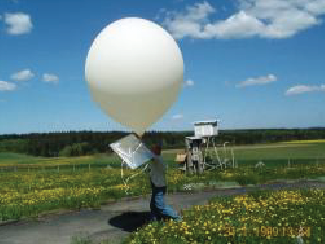
A weather balloon contains 8.80 moles of helium at a pressure of 0.992 atm and a temperature of 25 °C at ground level. What is the volume of the balloon under these conditions?
Answer
8-33 §8.2 source ↗
Answer
8-35 §8.2 source ↗
How many grams of gas are present in each of the following cases?
(a) 0.100 L of CO2 at 307 torr and 26 °C
(b) 8.75 L of C2H4, at 378.3 kPa and 483 K
(c) 221 mL of Ar at 0.23 torr and –54 °C
Answer
8-37 §8.2 source ↗
Answer
8-39 §8.2 source ↗
Answer
8-41 §8.2 source ↗
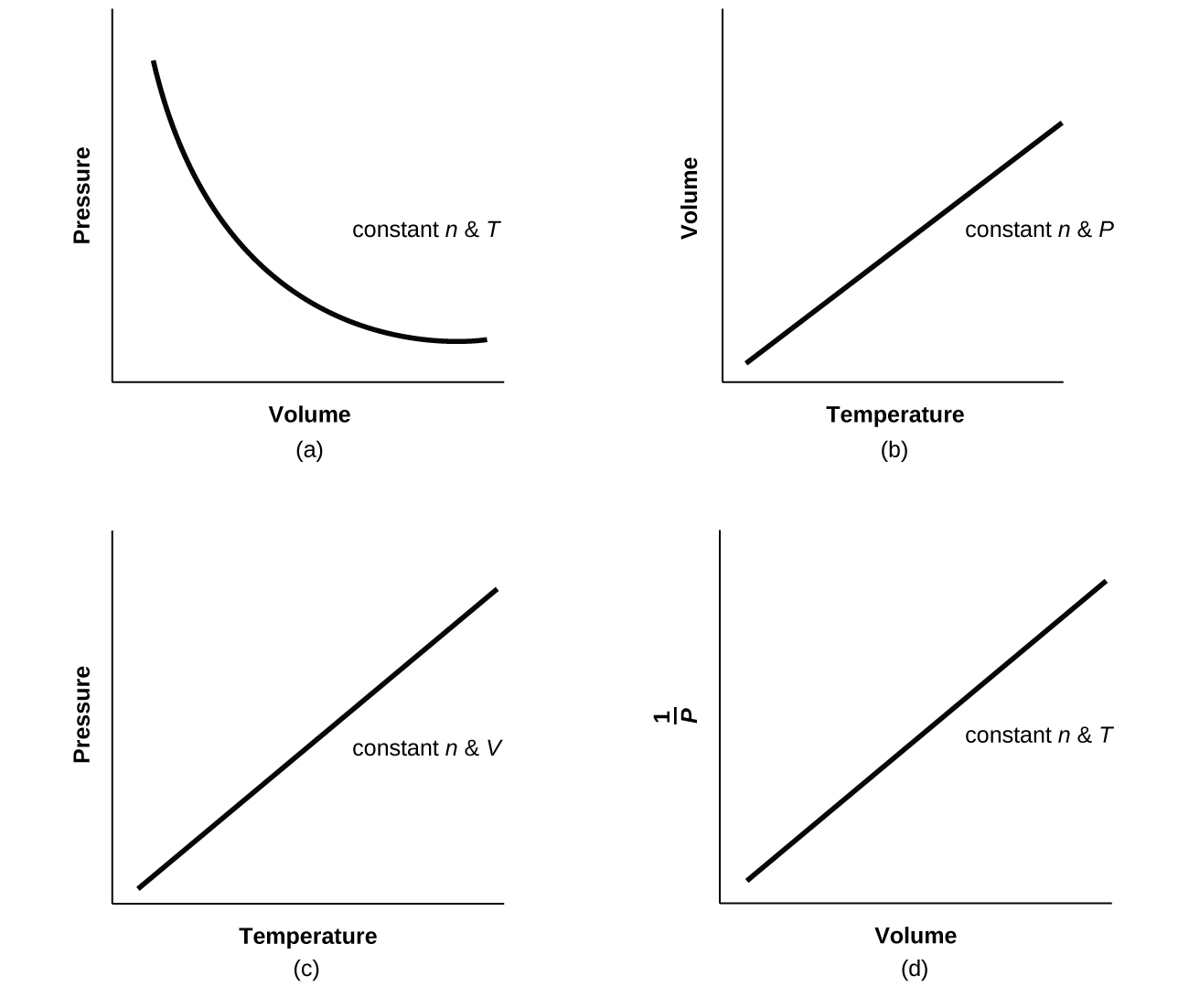
For a given amount of gas showing ideal behavior, draw labeled graphs of:
(a) the variation of P with V
(b) the variation of V with T
(c) the variation of P with T
(d) the variation of with V
Answer
For a gas exhibiting ideal behavior:
8-43 §8.2 source ↗
The effect of chlorofluorocarbons (such as CCl2F2) on the depletion of the ozone layer is well known. The use of substitutes, such as CH3CH2F(g), for the chlorofluorocarbons, has largely corrected the problem. Calculate the volume occupied by 10.0 g of each of these compounds at STP:
(a) CCl2F2(g)
(b) CH3CH2F(g)
Answer
8-45 §8.2 source ↗
Answer
8-47 §8.2 source ↗
Answer
8-49 §8.3 source ↗
Answer
8-51 §8.3 source ↗
Answer
8-53 §8.3 source ↗
Answer
8-55 §8.3 source ↗
Answer
8-57 §8.3 source ↗
Answer
8-59 §8.3 source ↗
Answer
8-61 §8.3 source ↗
Answer
8-63 §8.3 source ↗
| Temperature (°C) | Pressure (torr) | Temperature (°C) | Pressure (torr) | Temperature (°C) | Pressure (torr) | ||
|---|---|---|---|---|---|---|---|
| –10 | 1.95 | 18 | 15.5 | 30 | 31.8 | ||
| –5 | 3.0 | 19 | 16.5 | 35 | 42.2 | ||
| –2 | 3.9 | 20 | 17.5 | 40 | 55.3 | ||
| 0 | 4.6 | 21 | 18.7 | 50 | 92.5 | ||
| 2 | 5.3 | 22 | 19.8 | 60 | 149.4 | ||
| 4 | 6.1 | 23 | 21.1 | 70 | 233.7 | ||
| 6 | 7.0 | 24 | 22.4 | 80 | 355.1 | ||
| 8 | 8.0 | 25 | 23.8 | 90 | 525.8 | ||
| 10 | 9.2 | 26 | 25.2 | 95 | 633.9 | ||
| 12 | 10.5 | 27 | 26.7 | 99 | 733.2 | ||
| 14 | 12.0 | 28 | 28.3 | 100.0 | 760.0 | ||
| 16 | 13.6 | 29 | 30.0 | 101.0 | 787.6 |
Answer
8-65 §8.3 source ↗
Joseph Priestley first prepared pure oxygen by heating mercuric oxide, HgO:
(a) Outline the steps necessary to answer the following question: What volume of O2 at 23 °C and 0.975 atm is produced by the decomposition of 5.36 g of HgO?
(b) Answer the question.
Answer
8-67 §8.3 source ↗
The chlorofluorocarbon CCl2F2 can be recycled into a different compound by reaction with hydrogen to produce CH2F2(g), a compound useful in chemical manufacturing:
(a) Outline the steps necessary to answer the following question: What volume of hydrogen at 225 atm and 35.5 °C would be required to react with 1 ton (1.000 103 kg) of CCl2F2?
(b) Answer the question.
Answer
8-69 §8.3 source ↗
Lime, CaO, is produced by heating calcium carbonate, CaCO3; carbon dioxide is the other product.
(a) Outline the steps necessary to answer the following question: What volume of carbon dioxide at 875 K and 0.966 atm is produced by the decomposition of 1 ton (1.000 103 kg) of calcium carbonate?
(b) Answer the question.
Answer
8-71 §8.3 source ↗
Answer
8-73 §8.3 source ↗
Consider the following questions:
(a) What is the total volume of the CO2(g) and H2O(g) at 600 °C and 0.888 atm produced by the combustion of 1.00 L of C2H6(g) measured at STP?
(b) What is the partial pressure of H2O in the product gases?
Answer
8-75 §8.3 source ↗
Answer
8-77 §8.3 source ↗
Ethanol, C2H5OH, is produced industrially from ethylene, C2H4, by the following sequence of reactions:
What volume of ethylene at STP is required to produce 1.000 metric ton (1000 kg) of ethanol if the overall yield of ethanol is 90.1%?
Answer
8-79 §8.3 source ↗
Answer
8-81 §8.4 source ↗
Answer
8-83 §8.4 source ↗
Answer
Therefore,
8-85 §8.4 source ↗
Answer
8-87 §8.4 source ↗
Answer
8-89 §8.4 source ↗
Answer
8-91 §8.5 source ↗
Answer
8-93 §8.5 source ↗
Answer
8-95 §8.5 source ↗
A 1-L sample of CO initially at STP is heated to 546 K, and its volume is increased to 2 L.
(a) What effect do these changes have on the pressure exerted by the gas?
(b) What is the effect on the average kinetic energy of the molecules?
(c) What is the effect on the root mean square speed of the molecules?
Answer
8-97 §8.5 source ↗
Answer the following questions:
(a) Is the pressure of the gas in the hot-air balloon shown at the opening of this chapter greater than, less than, or equal to that of the atmosphere outside the balloon?
(b) Is the density of the gas in the hot-air balloon shown at the opening of this chapter greater than, less than, or equal to that of the atmosphere outside the balloon?
(c) At a pressure of 1 atm and a temperature of 20 °C, dry air has a density of 1.2256 g/L. What is the (average) molar mass of dry air?
(d) The average temperature of the gas in a hot-air balloon is 1.30 102 °F. Calculate its density, assuming the molar mass equals that of dry air.
(e) The lifting capacity of a hot-air balloon is equal to the difference in the mass of the cool air displaced by the balloon and the mass of the gas in the balloon. What is the difference in the mass of 1.00 L of the cool air in part (c) and the hot air in part (d)?
(f) An average balloon has a diameter of 60 feet and a volume of 1.1 105 ft3. What is the lifting power of such a balloon? If the weight of the balloon and its rigging is 500 pounds, what is its capacity for carrying passengers and cargo?
(g) A balloon carries 40.0 gallons of liquid propane (density 0.5005 g/L). What volume of CO2 and H2O gas is produced by the combustion of this propane at STP?
(h) A balloon flight can last about 90 minutes. If all of the fuel is burned during this time, what is the approximate rate of heat loss (in kJ/min) from the hot air in the bag during the flight?
Answer
8-99 §8.6 source ↗
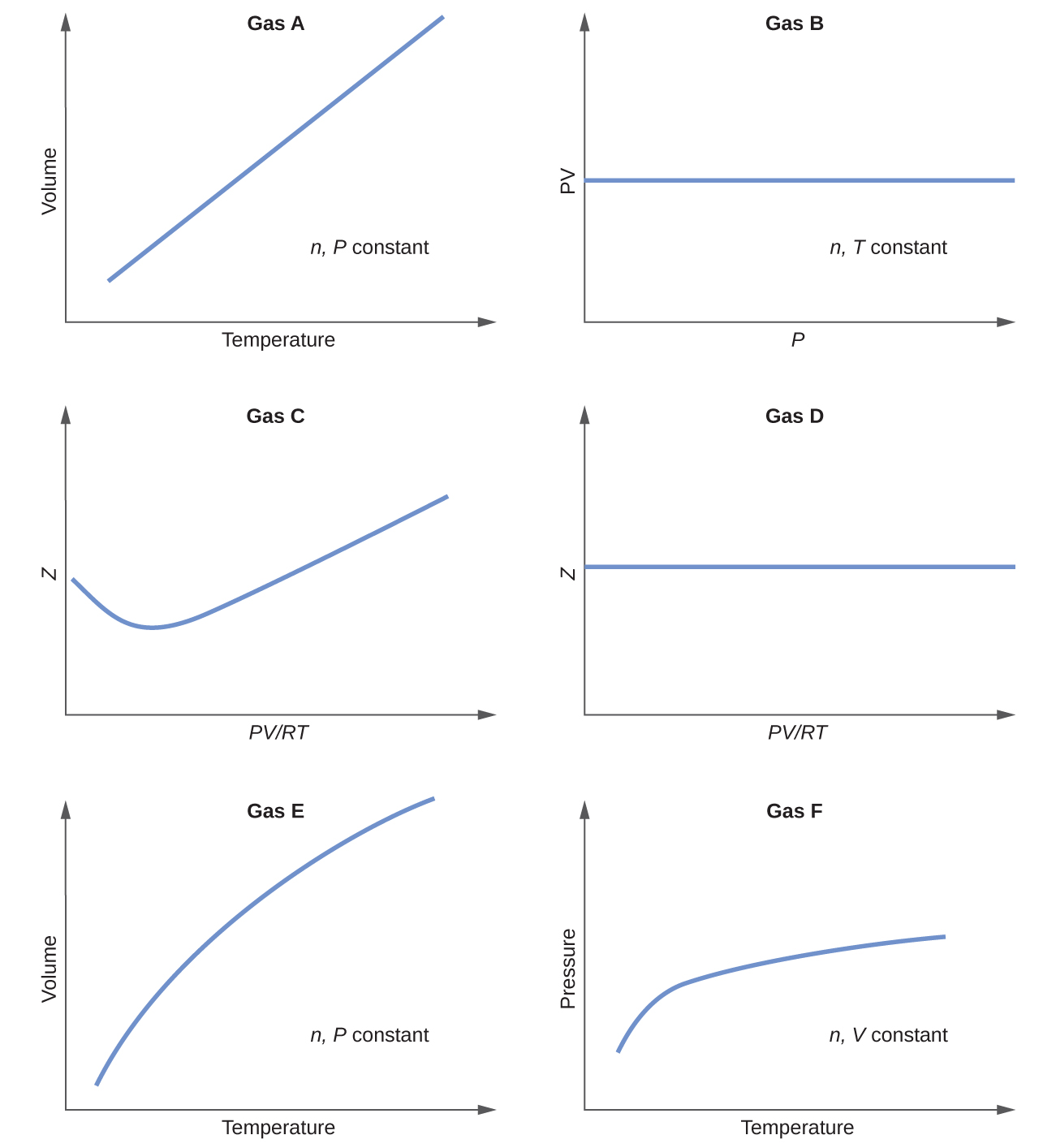
Graphs showing the behavior of several different gases follow. Which of these gases exhibit behavior significantly different from that expected for ideal gases?
Answer
8-101 §8.6 source ↗
Under which of the following sets of conditions does a real gas behave most like an ideal gas, and for which conditions is a real gas expected to deviate from ideal behavior? Explain.
(a) high pressure, small volume
(b) high temperature, low pressure
(c) low temperature, high pressure
Answer
8-103 §8.6 source ↗
For which of the following gases should the correction for the molecular volume be largest:
CO, CO2, H2, He, NH3, SF6?
Answer
8-105 §8.6 source ↗
Answer the following questions:
(a) If XX behaved as an ideal gas, what would its graph of Z vs. P look like?
(b) For most of this chapter, we performed calculations treating gases as ideal. Was this justified?
(c) What is the effect of the volume of gas molecules on Z? Under what conditions is this effect small? When is it large? Explain using an appropriate diagram.
(d) What is the effect of intermolecular attractions on the value of Z? Under what conditions is this effect small? When is it large? Explain using an appropriate diagram.
(e) In general, under what temperature conditions would you expect Z to have the largest deviations from the Z for an ideal gas?
Answer
Loading chapter 9…
Problems and answers are adapted from Chemistry: Atoms First 2e by Paul Flowers, Edward J. Neth, William R. Robinson, Klaus Theopold and Richard Langley, OpenStax, and are used under the CC BY-NC-SA 4.0 licence. Access for free at https://openstax.org/books/chemistry-atoms-first-2e/pages/1-introduction. Illustrations: Copyright Rice University, OpenStax, under CC BY-NC-SA 4.0 license. This adaptation is released under the same licence, is non-commercial, and is neither affiliated with nor endorsed by OpenStax or Rice University.