Every problem in the chapter beside the book’s answer, a chapter at a time as you scroll.
Chapter 15: Equilibria of Other Reaction Classes
68 problems · 10 figuresExample 15.1 §15.1 source ↗
(a) BaSO4
(b) Ag2SO4
(c) Al(OH)3
(d) Pb(OH)Cl
Answer
Example 15.2 §15.1 source ↗
Answer
Example 15.3 §15.1 source ↗
Answer
Example 15.4 §15.1 source ↗
Answer
Example 15.5 §15.1 source ↗
Answer
Example 15.6 §15.1 source ↗
Answer
Example 15.7 §15.1 source ↗
Answer
Example 15.8 §15.1 source ↗
Answer
Example 15.9 §15.1 source ↗
Answer
Example 15.10 §15.1 source ↗
Answer
Example 15.11 §15.1 source ↗
Answer
Example 15.12 §15.1 source ↗
(a) Ni(NO3)2
(b) KClO4
(c) NiCO3
(d) K2CO3
Answer
Example 15.13 §15.1 source ↗
Answer
Example 15.14 §15.2 source ↗
Answer
Example 15.15 §15.3 source ↗
Answer
Example 15.16 §15.3 source ↗
Answer
15-1 §15.1 source ↗
Complete the changes in concentrations for each of the following reactions:
(a)
(b)
(c)
(d)
(e)
Answer
(b)
(c)
(d)
(e)
15-3 §15.1 source ↗
Answer
15-5 §15.1 source ↗
Answer
15-7 §15.1 source ↗
Answer
15-9 §15.1 source ↗
Write the ionic equation for the dissolution and the Ksp expression for each of the following slightly soluble ionic compounds:
(a) LaF3
(b) CaCO3
(c) Ag2SO4
(d) Pb(OH)2
Answer
(b)
(c)
(d)
15-11 §15.1 source ↗
The Handbook of Chemistry and Physics gives solubilities of the following compounds in grams per 100 mL of water. Because these compounds are only slightly soluble, assume that the volume does not change on dissolution and calculate the solubility product for each.
(a) BaSeO4, 0.0118 g/100 mL
(b) Ba(BrO3)2·H2O, 0.30 g/100 mL
(c) NH4MgAsO4·6H2O, 0.038 g/100 mL
(d) La2(MoO4)3, 0.00179 g/100 mL
Answer
15-13 §15.1 source ↗
Assuming that no equilibria other than dissolution are involved, calculate the molar solubility of each of the following from its solubility product:
(a) KHC4H4O6
(b) PbI2
(c) Ag4[Fe(CN)6], a salt containing the ion
(d) Hg2I2
Answer
15-15 §15.1 source ↗
Assuming that no equilibria other than dissolution are involved, calculate the concentration of all solute species in each of the following solutions of salts in contact with a solution containing a common ion. Show that changes in the initial concentrations of the common ions can be neglected.
(a) AgCl(s) in 0.025 M NaCl
(b) CaF2(s) in 0.00133 M KF
(c) Ag2SO4(s) in 0.500 L of a solution containing 19.50 g of K2SO4
(d) Zn(OH)2(s) in a solution buffered at a pH of 11.45
Answer
(b) 2.2 10−5 M = [Ca2+], [F−] = 0.0013 M. Check: This value is less than 5% and can be ignored.
(c) 0.2238 M = [Ag+] = 7.4 10–3 M. Check: the condition is satisfied.
(d) [OH–] = 2.8 10–3 M; 5.7 10−12 M = [Zn2+]. Check: x is less than 5% of [OH–] and is, therefore, negligible.
15-17 §15.1 source ↗
Assuming that no equilibria other than dissolution are involved, calculate the concentration of all solute species in each of the following solutions of salts in contact with a solution containing a common ion. State whether or not it is appropriate to neglect the changes in the initial concentrations of the common ions.
(a) TlCl(s) in 0.025 M TlNO3
(b) BaF2(s) in 0.313 M KF
(c) MgC2O4 in 2.250 L of a solution containing 8.156 g of Mg(NO3)2
(d) Ca(OH)2(s) in an unbuffered solution initially with a pH of 12.700
Answer
[Ti+] =0.031 M
[Cl–] = 0.0056 M (b) The change in initial concentration of common ion may be neglected.
[Ba2+] = 2.4 10–4 M
[F–] = 0.313 M;
(c) The change in initial concentration of common ion may be neglected.
[Mg2+] = 0.0244 M
(d) The change in initial concentration of common ion may be neglected.
[Ca2+] = 5.18 10–4 M
[C2)42–] = 0.051 M
15-19 §15.1 source ↗
Answer
15-21 §15.1 source ↗
Answer
15-23 §15.1 source ↗
Answer
15-25 §15.1 source ↗
Answer
15-27 §15.1 source ↗
Assuming that no equilibria other than dissolution are involved, calculate the concentrations of ions in a saturated solution of each of the following (see Appendix J for solubility products):
(a) AgI
(b) Ag2SO4
(c) Mn(OH)2
(d) Sr(OH)2·8H2O
(e) the mineral brucite, Mg(OH)2
Answer
15-29 §15.1 source ↗
The following concentrations are found in mixtures of ions in equilibrium with slightly soluble solids. From the concentrations given, calculate Ksp for each of the slightly soluble solids indicated:
(a) TlCl: [Tl+] = 1.21 10–2 M, [Cl–] = 1.2 10–2 M
(b) Ce(IO3)4: [Ce4+] = 1.8 10–4 M, = 2.6 10–13 M
(c) Gd2(SO4)3: [Gd3+] = 0.132 M, = 0.198 M
(d) Ag2SO4: [Ag+] = 2.40 10–2 M, = 2.05 10–2 M
(e) BaSO4: [Ba2+] = 0.500 M, = 2.16 10−10 M
Answer
15-31 §15.1 source ↗
Which of the following compounds precipitates from a solution that has the concentrations indicated? (See Appendix J for Ksp values.)
(a) CaCO3: [Ca2+] = 0.003 M, = 0.003 M
(b) Co(OH)2: [Co2+] = 0.01 M, [OH–] = 1 10–7 M
(c) CaHPO4: [Ca2+] = 0.01 M, = 2 10–6 M
(d) Pb3(PO4)2: [Pb2+] = 0.01 M, = 1 10–13 M
Answer
15-33 §15.1 source ↗
Answer
15-35 §15.1 source ↗
Answer
15-37 §15.1 source ↗
Answer
15-39 §15.1 source ↗
Answer
15-41 §15.1 source ↗
Perform these calculations for nickel(II) carbonate. (a) With what volume of water must a precipitate containing NiCO3 be washed to dissolve 0.100 g of this compound? Assume that the wash water becomes saturated with NiCO3 (Ksp = 1.36 10–7).
(b) If the NiCO3 were a contaminant in a sample of CoCO3 (Ksp = 1.0 10–12), what mass of CoCO3 would have been lost? Keep in mind that both NiCO3 and CoCO3 dissolve in the same solution.
Answer
15-43 §15.1 source ↗
Answer
15-45 §15.1 source ↗
What reagent might be used to separate the ions in each of the following mixtures, which are 0.1 M with respect to each ion? In some cases it may be necessary to control the pH. (Hint: Consider the Ksp values given in Appendix J.)
(a) and Cu2+
(b) and Cl–
(c) Hg2+ and Co2+
(d) Zn2+ and Sr2+
(e) Ba2+ and Mg2+
(f) and OH–
Answer
15-47 §15.1 source ↗
Answer
15-49 §15.1 source ↗
Answer
15-51 §15.1 source ↗
Magnesium metal (a component of alloys used in aircraft and a reducing agent used in the production of uranium, titanium, and other active metals) is isolated from sea water by the following sequence of reactions:
Sea water has a density of 1.026 g/cm3 and contains 1272 parts per million of magnesium as Mg2+(aq) by mass. What mass, in kilograms, of Ca(OH)2 is required to precipitate 99.9% of the magnesium in 1.00 103 L of sea water?
Answer
15-53 §15.1 source ↗
Perform the following calculations involving concentrations of iodate ions:
(a) The iodate ion concentration of a saturated solution of La(IO3)3 was found to be 3.1 10–3 mol/L. Find the Ksp.
(b) Find the concentration of iodate ions in a saturated solution of Cu(IO3)2 (Ksp = 7.4 10–8).
Answer
15-55 §15.1 source ↗
Answer
15-57 §15.1 source ↗
Answer
1.23 10−3 g Mg(OH)2
15-59 §15.1 source ↗
The carbonate ion concentration is gradually increased in a solution containing equal concentrations of the divalent cations of magnesium, calcium, strontium, barium, and manganese. Which of the following carbonates will precipitate first? Which will precipitate last? Explain.
(a)
(b)
(c)
(d)
(e)
Answer
15-62 §15.2 source ↗
Answer
15-64 §15.2 source ↗
Answer
15-66 §15.2 source ↗
Sometimes equilibria for complex ions are described in terms of dissociation constants, Kd. For the complex ion the dissociation reaction is:
and
Calculate the value of the formation constant, Kf, for
Answer
15-68 §15.2 source ↗
Answer
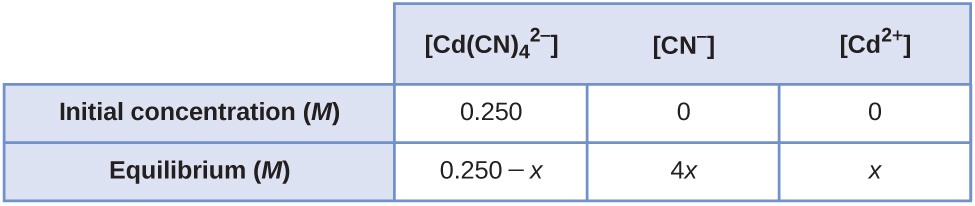
[Cd2+] = 5.0 10–5 M; [CN–] = 2.0 10–4 M
15-70 §15.2 source ↗
Answer
15-72 §15.2 source ↗
Answer
15-74 §15.2 source ↗
Answer
15-76 §15.2 source ↗
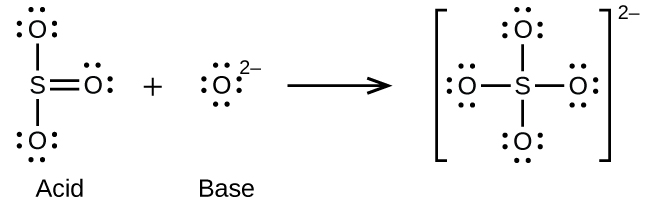
Write the Lewis structures of the reactants and product of each of the following equations, and identify the Lewis acid and the Lewis base in each:
(a)
(b)
(c)
(d) (use Al-Cl single bonds)
(e)
Answer
(a)
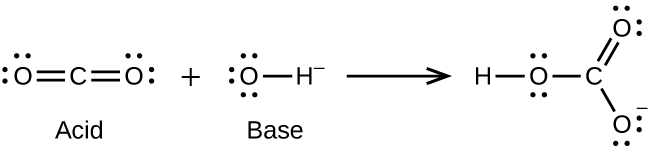
(b)
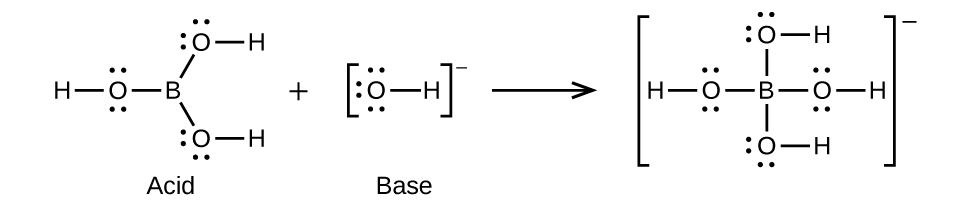
(c)

(d)
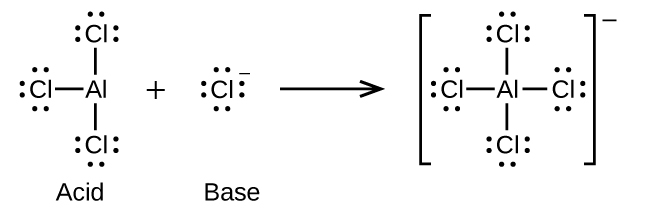
(e)
15-78 §15.2 source ↗
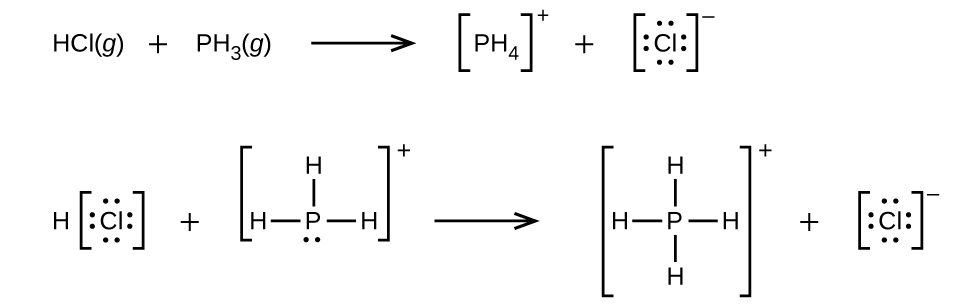
Using Lewis structures, write balanced equations for the following reactions:
(a)
(b)
(c)
(d)
Answer
(a)
(b)

(c)

(d)

15-80 §15.2 source ↗
Answer
15-82 §15.2 source ↗
Answer
15-84 §15.2 source ↗
Boric acid, H3BO3, is not a Brønsted-Lowry acid but a Lewis acid. (Hint: See the equation in Exercise 15.76)
(a) Write an equation for its reaction with water.
(b) Predict the shape of the anion thus formed.
(c) What is the hybridization on the boron, and is it consistent with the shape you have predicted?
Answer
15-86 §15.3 source ↗
Answer
15-88 §15.3 source ↗
Answer
15-90 §15.3 source ↗
Answer
15-93 §15.3 source ↗
Answer
15-95 §15.3 source ↗
Answer
15-97 §15.3 source ↗
Answer
15-99 §15.3 source ↗
A 0.125-M solution of Mn(NO3)2 is saturated with H2S ([H2S] = 0.10 M). At what pH does MnS begin to precipitate?
Answer
15-101 §15.3 source ↗
The following question is taken from a Chemistry Advanced Placement Examination and is used with the permission of the Educational Testing Service.
Solve the following problem:
In a saturated solution of MgF2 at 18 °C, the concentration of Mg2+ is 1.21 10–3 M. The equilibrium is represented by the preceding equation.
(a) Write the expression for the solubility-product constant, Ksp, and calculate its value at 18 °C.
(b) Calculate the equilibrium concentration of Mg2+ in 1.000 L of saturated MgF2 solution at 18 °C to which 0.100 mol of solid KF has been added. The KF dissolves completely. Assume the volume change is negligible.
(c) Predict whether a precipitate of MgF2 will form when 100.0 mL of a 3.00 10–3-M solution of Mg(NO3)2 is mixed with 200.0 mL of a 2.00 10–3-M solution of NaF at 18 °C. Show the calculations to support your prediction.
(d) At 27 °C the concentration of Mg2+ in a saturated solution of MgF2 is 1.17 10–3 M. Is the dissolving of MgF2 in water an endothermic or an exothermic process? Give an explanation to support your conclusion.
Answer
(b) 7.09 10–7 M
(c) Determine the concentration of Mg2+ and F– that will be present in the final volume. Compare the value of the ion product [Mg2+][F–]2 with Ksp. If this value is larger than Ksp, precipitation will occur.
0.1000 L 3.00 10–3 M Mg(NO3)2 = 0.3000 L M Mg(NO3)2
M Mg(NO3)2 = 1.00 10–3 M
0.2000 L 2.00 10–3 M NaF = 0.3000 L M NaF
M NaF = 1.33 10–3 M
ion product = (1.00 10–3)(1.33 10–3)2 = 1.77 10–9 This value is smaller than Ksp, so no precipitation will occur.
(d) MgF2 is less soluble at 27 °C than at 18 °C. Because added heat acts like an added reagent, when it appears on the product side, the Le Châtelier’s principle states that the equilibrium will shift to the reactants’ side to counter the stress. Consequently, less reagent will dissolve. This situation is found in our case. Therefore, the reaction is exothermic.
15-103 §15.3 source ↗
Answer
15-105 §15.3 source ↗
What is the effect on the amount of CaHPO4 that dissolves and the concentrations of Ca2+ and when each of the following are added to a mixture of solid CaHPO4 and water at equilibrium?
(a) CaCl2
(b) HCl
(c) KClO4
(d) NaOH
(e) CaHPO4
Answer
Loading chapter 16…
Problems and answers are adapted from Chemistry: Atoms First 2e by Paul Flowers, Edward J. Neth, William R. Robinson, Klaus Theopold and Richard Langley, OpenStax, and are used under the CC BY-NC-SA 4.0 licence. Access for free at https://openstax.org/books/chemistry-atoms-first-2e/pages/1-introduction. Illustrations: Copyright Rice University, OpenStax, under CC BY-NC-SA 4.0 license. This adaptation is released under the same licence, is non-commercial, and is neither affiliated with nor endorsed by OpenStax or Rice University.