Every problem in the chapter beside the book’s answer, a chapter at a time as you scroll.

Chapter 11: Solutions and Colloids

51 problems · 6 figures

Example 11.1 §11.3 source ↗

Exposing a 100.0 mL sample of water at 0 °C to an atmosphere containing a gaseous solute at 152 torr resulted in the dissolution of 1.45 × 10⁻³ g of the solute. Use Henry’s law to determine the solubility of this gaseous solute when its pressure is 760 torr.

Answer

7.25 × 10⁻³ in 100.0 mL or 0.0725 g/L

Example 11.2 §11.3 source ↗

What dissolved oxygen concentration is expected for the stream above when it returns to a normal summer time temperature of 15 °C?

Answer

8.2 mg/L

Example 11.3 §11.4 source ↗

What are the mole fraction and molality of a solution that contains 0.850 g of ammonia, NH3, dissolved in 125 g of water?

Answer

7.14 × 10⁻³; 0.399 m

Example 11.4 §11.4 source ↗

The mole fraction of iodine, I2, dissolved in dichloromethane, CH2Cl2, is 0.115. What is the molal concentration, m, of iodine in this solution?

Answer

1.53 m

Example 11.5 §11.4 source ↗

Nitric acid, HNO3(aq), is commercially available as a 33.7 m aqueous solution (density = 1.35 g/mL). What is the molarity of this solution?

Answer

14.6 M

Example 11.6 §11.4 source ↗

A solution contains 5.00 g of urea, CO(NH2)2 (a nonvolatile solute) and 0.100 kg of water. If the vapor pressure of pure water at 25 °C is 23.7 torr, what is the vapor pressure of the solution assuming ideal behavior?

Answer

23.4 torr

Example 11.7 §11.4 source ↗

Assuming ideal solution behavior, what is the boiling point of the antifreeze described in Example 11.3?

Answer

109.2 °C

Example 11.8 §11.4 source ↗

What is the boiling point of a solution of 1.0 g of glycerin, C3H5(OH)3, in 47.8 g of water? Assume an ideal solution.

Answer

100.12 °C

Example 11.9 §11.4 source ↗

Assuming ideal solution behavior, what is the freezing point of a 1.85 m solution of a nonvolatile nonelectrolyte solute in nitrobenzene?

Answer

−9.3 °C

Example 11.10 §11.4 source ↗

Assuming ideal solution behavior, what is the osmotic pressure (atm) a solution with a volume of 0.750 L that contains 5.0 g of methanol, CH3OH, in water at 37 °C?

Answer

5.3 atm

Example 11.11 §11.4 source ↗

A solution of 35.7 g of a nonelectrolyte in 220.0 g of chloroform has a boiling point of 64.5 °C. Assuming ideal solution behavior, what is the molar mass of this compound?

Answer

1.8 × 10² g/mol

Example 11.12 §11.4 source ↗

Assuming ideal solution behavior, what is the molar mass of a protein if a solution of 0.02 g of the protein in 25.0 mL of solution has an osmotic pressure of 0.56 torr at 25 °C?

Answer

3 × 10⁴ g/mol

Example 11.13 §11.4 source ↗

Assuming complete dissociation and ideal solution behavior, calculate the freezing point of a solution of 0.724 g of CaCl2 in 175 g of water.

Answer

−0.208 °C

11-1 §11.1 source ↗

How do solutions differ from compounds? From other mixtures?

Answer

A solution can vary in composition, while a compound cannot vary in composition. Solutions are homogeneous at the molecular level, while other mixtures are heterogeneous.

11-3 §11.1 source ↗

When KNO3 is dissolved in water, the resulting solution is significantly colder than the water was originally.

(a) Is the dissolution of KNO3 an endothermic or an exothermic process?

(b) What conclusions can you draw about the intermolecular attractions involved in the process?

(c) Is the resulting solution an ideal solution?

Answer

(a) The process is endothermic as the solution is consuming heat. (b) Attraction between the K+ and NO3− ions is stronger than between the ions and water molecules (the ion-ion interactions have a lower, more negative energy). Therefore, the dissolution process increases the energy of the molecular interactions, and it consumes the thermal energy of the solution to make up for the difference. (c) No, an ideal solution is formed with no appreciable heat release or consumption.

11-5 §11.1 source ↗

Indicate the most important types of intermolecular attractions in each of the following solutions:

(a) The solution in Figure 11.2.

(b) NO(l) in CO(l)

(c) Cl2(g) in Br2(l)

(d) HCl(g) in benzene C6H6(l)

(e) Methanol CH3OH(l) in H2O(l)

Figure 11.2 in the book ↗
When potassium dichromate (K2Cr2O7) is mixed with water, it forms a homogeneous orange solution. (credit: modification of work by Mark Ott)

Answer

(a) ion-dipole forces; (b) dipole-dipole forces; (c) dispersion forces; (d) dispersion forces; (e) hydrogen bonding

11-7 §11.1 source ↗

Heat is released when some solutions form; heat is absorbed when other solutions form. Provide a molecular explanation for the difference between these two types of spontaneous processes.

Answer

Heat is released when the total intermolecular forces (IMFs) between the solute and solvent molecules are stronger than the total IMFs in the pure solute and in the pure solvent: Breaking weaker IMFs and forming stronger IMFs releases heat. Heat is absorbed when the total IMFs in the solution are weaker than the total of those in the pure solute and in the pure solvent: Breaking stronger IMFs and forming weaker IMFs absorbs heat.

11-9 §11.2 source ↗

Explain why the ions Na+ and Cl− are strongly solvated in water but not in hexane, a solvent composed of nonpolar molecules.

Answer

Crystals of NaCl dissolve in water, a polar liquid with a very large dipole moment, and the individual ions become strongly solvated. Hexane is a nonpolar liquid with a dipole moment of zero and, therefore, does not significantly interact with the ions of the NaCl crystals.

11-11 §11.2 source ↗

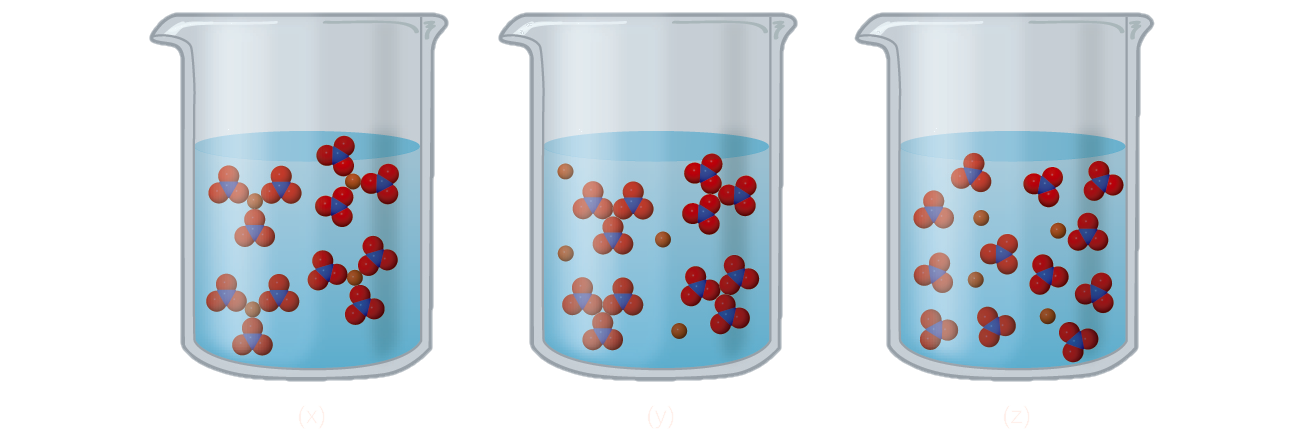
Consider the solutions presented:

(a) Which of the following sketches best represents the ions in a solution of Fe(NO3)3(aq)?
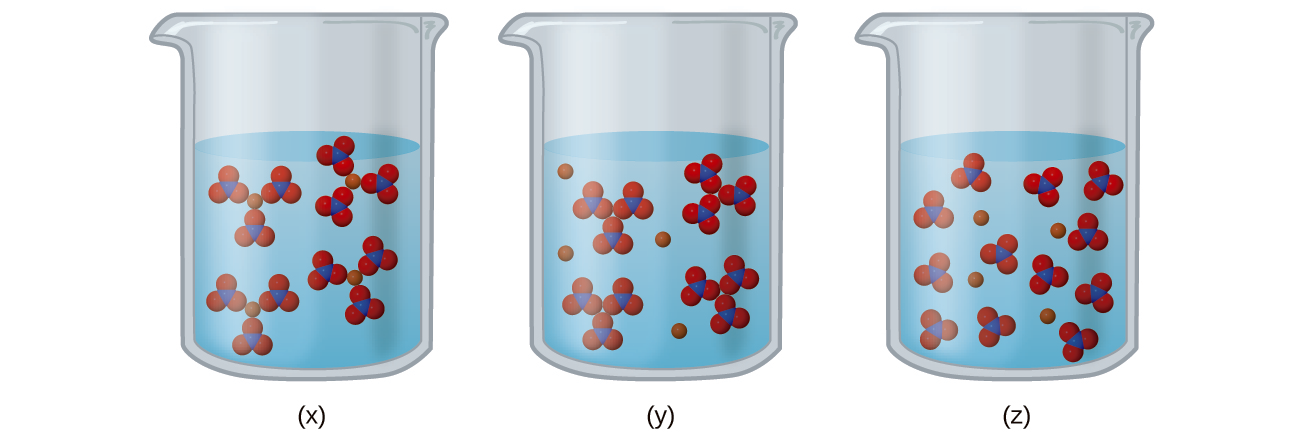
In this figure, three beakers labeled x, y, and z are shown containing various arrangements of blue and red spheres suspended in solution. In beaker x, three small red spheres surround a single central blue sphere in small clusters which in turn are grouped in threes around a single red sphere, forming four larger clusters. In beaker y, the four large clusters are present without the central red spheres. Four individual red spheres are now present. In beaker z, the large clusters are not present. Twelve of the small clusters of three red and one blue sphere are present along with four single red spheres.In this figure, three beakers labeled x, y, and z are shown containing various arrangements of blue and red spheres suspended in solution. In beaker x, three small red spheres surround a single central blue sphere in small clusters which in turn are grouped in threes around a single red sphere, forming four larger clusters. In beaker y, the four large clusters are present without the central red spheres. Four individual red spheres are now present. In beaker z, the large clusters are not present. Twelve of the small clusters of three red and one blue sphere are present along with four single red spheres.

(b) Write a balanced chemical equation showing the products of the dissolution of Fe(NO3)3.

Answer

(a) Fe(NO3)3 is a strong electrolyte, thus it should completely dissociate into Fe3+ and NO3− ions. Therefore, (z) best represents the solution. (b) Fe(NO3)3(s)⟶ Fe3+(aq)+ 3NO3−(aq)

11-13 §11.2 source ↗

What is the expected electrical conductivity of the following solutions?

(a) NaOH(aq)

(b) HCl(aq)

(c) C6H12O6(aq) (glucose)

(d) NH3(aq)

Answer

(a) high conductivity (solute is an ionic compound that will dissociate when dissolved); (b) high conductivity (solute is a strong acid and will ionize completely when dissolved); (c) nonconductive (solute is a covalent compound, neither acid nor base, unreactive towards water); (d) low conductivity (solute is a weak base and will partially ionize when dissolved)

11-15 §11.2 source ↗

Indicate the most important type of intermolecular attraction responsible for solvation in each of the following solutions:

(a) the solutions in Figure 11.7

(b) methanol, CH3OH, dissolved in ethanol, C2H5OH

(c) methane, CH4, dissolved in benzene, C6H6

(d) the polar halocarbon CF2Cl2 dissolved in the polar halocarbon CF2ClCFCl2

(e) O2(l) in N2(l)

Figure 11.7 in the book ↗
As potassium chloride (KCl) dissolves in water, the ions are hydrated. The polar water molecules are attracted by the charges on the K+ and Cl− ions. Water molecules in front of and behind the ions are not shown.

Answer

(a) ion-dipole; (b) hydrogen bonds; (c) dispersion forces; (d) dipole-dipole attractions; (e) dispersion forces

11-17 §11.3 source ↗

Supersaturated solutions of most solids in water are prepared by cooling saturated solutions. Supersaturated solutions of most gases in water are prepared by heating saturated solutions. Explain the reasons for the difference in the two procedures.

Answer

The solubility of solids usually decreases upon cooling a solution, while the solubility of gases usually decreases upon heating.

11-19 §11.3 source ↗

Calculate the percent by mass of KBr in a saturated solution of KBr in water at 10 °C. See Figure 11.16 for useful data, and report the computed percentage to one significant digit.
Figure 11.16 in the book ↗
This graph shows how the solubility of several solids changes with temperature.

Answer

40%

11-21 §11.3 source ↗

At 0 °C and 1.00 atm, as much as 0.70 g of O2 can dissolve in 1 L of water. At 0 °C and 4.00 atm, how many grams of O2 dissolve in 1 L of water?

Answer

2.8 g

11-23 §11.3 source ↗

The Henry’s law constant for CO2 is 3.4 × 10⁻² M/atm at 25 °C. Assuming ideal solution behavior, what pressure of carbon dioxide is needed to maintain a CO2 concentration of 0.10 M in a can of lemon-lime soda?

Answer

2.9 atm

11-25 §11.3 source ↗

Assuming ideal solution behavior, how many liters of HCl gas, measured at 30.0 °C and 745 torr, are required to prepare 1.25 L of a 3.20-M solution of hydrochloric acid?

Answer

102 L HCl

11-27 §11.4 source ↗

What is the microscopic explanation for the macroscopic behavior illustrated in Figure 11.14?
Figure 11.14 in the book ↗
Water and oil are immiscible. Mixtures of these two substances will form two separate layers with the less dense oil floating on top of the water. (credit: “Yortw”/Flickr)

Answer

The strength of the bonds between like molecules is stronger than the strength between unlike molecules. Therefore, some regions will exist in which the water molecules will exclude oil molecules and other regions will exist in which oil molecules will exclude water molecules, forming a heterogeneous region.

11-29 §11.4 source ↗

A solution of potassium nitrate, an electrolyte, and a solution of glycerin (C3H5(OH)3), a nonelectrolyte, both boil at 100.3 °C. What other physical properties of the two solutions are identical?

Answer

Both form homogeneous solutions; their boiling point elevations are the same, as are their lowering of vapor pressures. Osmotic pressure and the lowering of the freezing point are also the same for both solutions.

11-31 §11.4 source ↗

What are the mole fractions of HNO3 and water in a concentrated solution of nitric acid (68.0% HNO3 by mass)?

(a) Outline the steps necessary to answer the question.

(b) Answer the question.

Answer

(a) Find number of moles of HNO3 and H2O in 100 g of the solution. Find the mole fractions for the components. (b) The mole fraction of HNO3 is 0.378. The mole fraction of H2O is 0.622.

11-33 §11.4 source ↗

Calculate the mole fraction of each solute and solvent:

(a) 0.710 kg of sodium carbonate (washing soda), Na2CO3, in 10.0 kg of water—a saturated solution at 0 °C

(b) 125 g of NH4NO3 in 275 g of water—a mixture used to make an instant ice pack

(c) 25 g of Cl2 in 125 g of dichloromethane, CH2Cl2

(d) 0.372 g of tetrahydropyridine, C5H9N, in 125 g of chloroform, CHCl3

Answer

(a) XNa2CO3= 0.0119; XH2O=0.988; (b) XNH4NO3= 0.0928; XH2O=0.907; (c) XCl2=0.192; XCH2CI2= 0.808; (d) XC5H9N= 0.00426; XCHCl3= 0.997

11-35 §11.4 source ↗

What is the difference between a 1 M solution and a 1 m solution?

Answer

In a 1 M solution, the mole is contained in exactly 1 L of solution. In a 1 m solution, the mole is contained in exactly 1 kg of solvent.

11-37 §11.4 source ↗

What is the molality of nitric acid in a concentrated solution of nitric acid (68.0% HNO3 by mass)?

(a) Outline the steps necessary to answer the question.

(b) Answer the question.

Answer

(a) Determine the molar mass of HNO3. Determine the number of moles of acid in the solution. From the number of moles and the mass of solvent, determine the molality. (b) 33.7 m

11-39 §11.4 source ↗

Calculate the molality of each of the following solutions:

(a) 0.710 kg of sodium carbonate (washing soda), Na2CO3, in 10.0 kg of water—a saturated solution at 0°C

(b) 125 g of NH4NO3 in 275 g of water—a mixture used to make an instant ice pack

(c) 25 g of Cl2 in 125 g of dichloromethane, CH2Cl2

(d) 0.372 g of tetrahydropyridine, C5H9N, in 125 g of chloroform, CHCl3

Answer

(a) 6.70 × 10⁻¹ m; (b) 5.67 m; (c) 2.8 m; (d) 0.0358 m

11-41 §11.4 source ↗

A 13.0% solution of K2CO3 by mass has a density of 1.09 g/cm3. Calculate the molality of the solution.

Answer

1.08 m

11-43 §11.4 source ↗

Assuming ideal solution behavior, what is the boiling point of a solution of 115.0 g of nonvolatile sucrose, C12H22O11, in 350.0 g of water?

(a) Outline the steps necessary to answer the question

(b) Answer the question

Answer

(a) Determine the molar mass of sucrose; determine the number of moles of sucrose in the solution; convert the mass of solvent to units of kilograms; from the number of moles and the mass of solvent, determine the molality; determine the difference between the boiling point of water and the boiling point of the solution; determine the new boiling point. (b) 100.5 °C

11-45 §11.4 source ↗

Assuming ideal solution behavior, what is the freezing temperature of a solution of 115.0 g of sucrose, C12H22O11, in 350.0 g of water?

(a) Outline the steps necessary to answer the question.

(b) Answer the question.

Answer

(a) Determine the molar mass of sucrose; determine the number of moles of sucrose in the solution; convert the mass of solvent to units of kilograms; from the number of moles and the mass of solvent, determine the molality; determine the difference between the freezing temperature of water and the freezing temperature of the solution; determine the new freezing temperature. (b) −1.8 °C

11-47 §11.4 source ↗

Assuming ideal solution behavior, what is the osmotic pressure of an aqueous solution of 1.64 g of Ca(NO3)2 in water at 25 °C? The volume of the solution is 275 mL.

(a) Outline the steps necessary to answer the question.

(b) Answer the question.

Answer

(a) Determine the molar mass of Ca(NO3)2; determine the number of moles of Ca(NO3)2 in the solution; determine the number of moles of ions in the solution; determine the molarity of ions, then the osmotic pressure. (b) 2.67 atm

11-49 §11.4 source ↗

A solution containing 5.00 g of a compound dissolved in 25.00 g of carbon tetrachloride (bp 76.8 °C; Kb = 5.02 °C/m) exhibits a normal boiling point of 81.5 °C. Assuming ideal solution behavior, what is the molar mass of the compound?

(a) Outline the steps necessary to answer the question.

(b) Solve the problem.

Answer

(a) Determine the molal concentration from the change in boiling point and Kb; determine the moles of solute in the solution from the molal concentration and mass of solvent; determine the molar mass from the number of moles and the mass of solute. (b) 2.1 × 10² g mol−1

11-51 §11.4 source ↗

A 1.0 m solution of HCl in benzene has a freezing point of 0.4 °C. Is HCl an electrolyte in benzene? Explain.

Answer

No. Pure benzene freezes at 5.5 °C, and so the observed freezing point of this solution is depressed by ΔTf = 5.5 − 0.4 = 5.1 °C. The value computed, assuming no ionization of HCl, is ΔTf = (1.0 m)(5.14 °C/m) = 5.1 °C. Agreement of these values supports the assumption that HCl is not ionized.

11-53 §11.4 source ↗

A 12.0-g sample of a nonelectrolyte is dissolved in 80.0 g of water. The solution freezes at −1.94 °C. Assuming ideal solution behavior, calculate the molar mass of the substance.

Answer

144 g mol−1

11-55 §11.4 source ↗

Calculate the boiling point elevation of 0.100 kg of water containing 0.010 mol of NaCl, 0.020 mol of Na2SO4, and 0.030 mol of MgCl2, assuming complete dissociation of these electrolytes and ideal solution behavior.

Answer

0.870 °C

11-57 §11.4 source ↗

A sample of sulfur weighing 0.210 g was dissolved in 17.8 g of carbon disulfide, CS2 (Kb = 2.34 °C/m). If the boiling point elevation was 0.107 °C, what is the formula of a sulfur molecule in carbon disulfide (assuming ideal solution behavior)?

Answer

S8

11-59 §11.4 source ↗

Lysozyme is an enzyme that cleaves cell walls. A 0.100-L sample of a solution of lysozyme that contains 0.0750 g of the enzyme exhibits an osmotic pressure of 1.32 × 10⁻³ atm at 25 °C. Assuming ideal solution behavior, what is the molar mass of lysozyme?

Answer

1.39 × 10⁴ g mol−1

11-61 §11.4 source ↗

The osmotic pressure of human blood is 7.6 atm at 37 °C. What mass of glucose, C6H12O6, is required to make 1.00 L of aqueous solution for intravenous feeding if the solution must have the same osmotic pressure as blood at body temperature, 37 °C (assuming ideal solution behavior)?

Answer

54 g

11-63 §11.4 source ↗

Assuming ideal solution behavior, what is the boiling point of a solution of NaCl in water if the solution freezes at −0.93 °C?

Answer

100.26 °C

11-65 §11.4 source ↗

The vapor pressure of methanol, CH3OH, is 94 torr at 20 °C. The vapor pressure of ethanol, C2H5OH, is 44 torr at the same temperature.

(a) Calculate the mole fraction of methanol and of ethanol in a solution of 50.0 g of methanol and 50.0 g of ethanol.

(b) Ethanol and methanol form a solution that behaves like an ideal solution. Calculate the vapor pressure of methanol and of ethanol above the solution at 20 °C.

(c) Calculate the mole fraction of methanol and of ethanol in the vapor above the solution.

Answer

(a) XCH3OH= 0.590; XC2H5OH= 0.410; (b) Vapor pressures are: CH3OH: 55 torr; C2H5OH: 18 torr; (c) CH3OH: 0.75; C2H5OH: 0.25

11-67 §11.4 source ↗

Meat can be classified as fresh (not frozen) even though it is stored at −1 °C. Why wouldn’t meat freeze at this temperature?

Answer

The ions and compounds present in the water in the beef lower the freezing point of the beef below −1 °C.

11-69 §11.4 source ↗

A sample of HgCl2 weighing 9.41 g is dissolved in 32.75 g of ethanol, C2H5OH (Kb = 1.20 °C/m). The boiling point elevation of the solution is 1.27 °C. Is HgCl2 an electrolyte in ethanol? Show your calculations.

Answer

Δbp= Kbm= (1.20°C/m)(9.41g×1mol HgCl2271.496g0.03275kg)= 1.27°C
The observed change equals the theoretical change; therefore, no dissociation occurs.

11-71 §11.5 source ↗

Identify the dispersed phase and the dispersion medium in each of the following colloidal systems: starch dispersion, smoke, fog, pearl, whipped cream, floating soap, jelly, milk, and ruby.

Answer

Colloidal System Dispersed Phase Dispersion Medium
starch dispersion starch water
smoke solid particles air
fog water air
pearl water calcium carbonate (CaCO3)
whipped cream air cream
floating soap air soap
jelly fruit juice pectin gel
milk butterfat water
ruby chromium(III) oxide (Cr2O3) aluminum oxide (Al2O3)

11-73 §11.5 source ↗

How do colloids differ from solutions with regard to dispersed particle size and homogeneity?

Answer

Colloidal dispersions consist of particles that are much bigger than the solutes of typical solutions. Colloidal particles are either very large molecules or aggregates of smaller species that usually are big enough to scatter light. Colloids are homogeneous on a macroscopic (visual) scale, while solutions are homogeneous on a microscopic (molecular) scale.

11-75 §11.5 source ↗

How can it be demonstrated that colloidal particles are electrically charged?

Answer

If they are placed in an electrolytic cell, dispersed particles will move toward the electrode that carries a charge opposite to their own charge. At this electrode, the charged particles will be neutralized and will coagulate as a precipitate.

Loading chapter 12…

Problems and answers are adapted from Chemistry: Atoms First 2e by Paul Flowers, Edward J. Neth, William R. Robinson, Klaus Theopold and Richard Langley, OpenStax, and are used under the CC BY-NC-SA 4.0 licence. Access for free at https://openstax.org/books/chemistry-atoms-first-2e/pages/1-introduction. Illustrations: Copyright Rice University, OpenStax, under CC BY-NC-SA 4.0 license. This adaptation is released under the same licence, is non-commercial, and is neither affiliated with nor endorsed by OpenStax or Rice University.