Every problem in the chapter beside the book’s answer, a chapter at a time as you scroll.

Chapter 17: Kinetics

59 problems · 11 figures

Example 17.1 §17.1 source ↗

The rate of formation of Br2 is 6.0 × 10⁻⁶ mol/L/s in a reaction described by the following net ionic equation: 5Br−+BrO3−+6H+⟶3Br2+3H2O

Write the equations that relate the rates of consumption of the reactants and the rates of formation of the products.

Answer

− 15Δ[Br−]Δt= − Δ[BrO3−]Δt= − 16Δ[H+]Δt= 13Δ[Br2]Δt= 13Δ[H2O]Δt

Example 17.2 §17.1 source ↗

If the rate of decomposition of ammonia, NH3, at 1150 K is 2.10 × 10⁻⁶ mol/L/s, what is the rate of production of nitrogen and hydrogen?

Answer

1.05 × 10⁻⁶ mol/L/s, N2 and 3.15 × 10⁻⁶ mol/L/s, H2.

Example 17.3 §17.3 source ↗

The rate law for the reaction: H2(g)+2NO(g)⟶N2O(g)+H2O(g)

has been determined to be rate = k[NO]2[H2]. What are the orders with respect to each reactant, and what is the overall order of the reaction?

Answer

order in NO = 2; order in H2 = 1; overall order = 3

Example 17.4 §17.3 source ↗

Acetaldehyde decomposes when heated to yield methane and carbon monoxide according to the equation: CH3CHO(g)⟶CH4(g)+CO(g)

Determine the rate law and the rate constant for the reaction from the following experimental data:

Trial [CH3CHO] (mol/L) − Δ[CH3CHO]Δt(molL−1s−1)
1 1.75 × 10⁻³ 2.06 × 10⁻¹¹
2 3.50 × 10⁻³ 8.24 × 10⁻¹¹
3 7.00 × 10⁻³ 3.30 × 10⁻¹⁰

Answer

rate= k[CH3CHO]2 with k = 6.73 × 10⁻⁶ L/mol/s

Example 17.5 §17.3 source ↗

Use the provided initial rate data to derive the rate law for the reaction whose equation is: OCl−(aq)+I−(aq)⟶OI−(aq)+Cl−(aq)
Trial [OCl−] (mol/L) [I−] (mol/L) Initial Rate (mol/L/s)
1 0.0040 0.0020 0.00184
2 0.0020 0.0040 0.00092
3 0.0020 0.0020 0.00046

Determine the rate law expression and the value of the rate constant k with appropriate units for this reaction.

Answer

rate 2rate 3= 0.000920.00046= k(0.0020)x(0.0040)yk(0.0020)x(0.0020)y
2.00 = 2.00y
y = 1
rate 1rate 2= 0.001840.00092= k(0.0040)x(0.0020)yk(0.0020)x(0.0040)y
2.00=2x2y2.00=2x214.00=2xx=2
Substituting the concentration data from trial 1 and solving for k yields:
rate=k[OCl−]2[I−]10.00184=k(0.0040)2(0.0020)1k=5.75×10⁴mol−2L2s−1

Example 17.6 §17.4 source ↗

Iodine-131 is a radioactive isotope that is used to diagnose and treat some forms of thyroid cancer. Iodine-131 decays to xenon-131 according to the equation: I-131⟶Xe-131+electron

The decay is first-order with a rate constant of 0.138 d−1. How many days will it take for 90% of the iodine−131 in a 0.500 M solution of this substance to decay to Xe-131?

Answer

16.7 days

Example 17.7 §17.4 source ↗

Graph the following data to determine whether the reaction A⟶B+C is first order.
Time (s) [A]
4.0 0.220
8.0 0.144
12.0 0.110
16.0 0.088
20.0 0.074

Answer

The plot of ln[A]t vs. t is not linear, indicating the reaction is not first order:
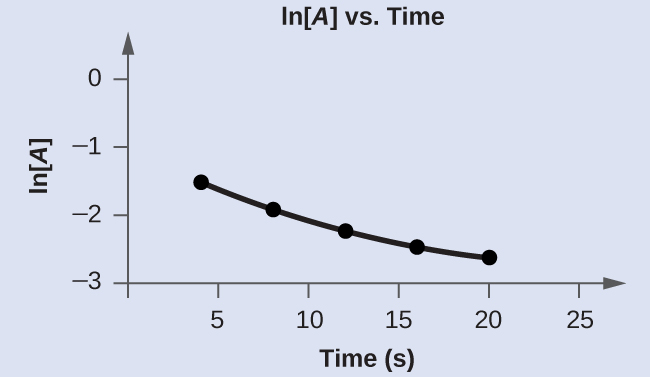
A graph, labeled above as “l n [ A ] vs. Time” is shown. The x-axis is labeled, “Time ( s )” and the y-axis is labeled, “l n [ A ].” The x-axis shows markings at 5, 10, 15, 20, and 25 hours. The y-axis shows markings at negative 3, negative 2, negative 1, and 0. A slight curve is drawn connecting five points at coordinates of approximately (4, negative 1.5), (8, negative 2), (12, negative 2.2), (16, negative 2.4), and (20, negative 2.6).

Example 17.8 §17.4 source ↗

If the initial concentration of butadiene is 0.0200 M, what is the concentration remaining after 20.0 min?

Answer

0.0195 mol/L

Example 17.9 §17.4 source ↗

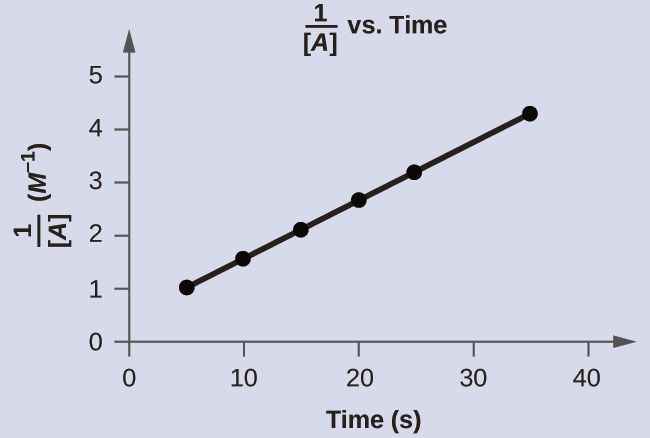
Do the following data fit a second-order rate law?
Time (s) [A] (M)
5 0.952
10 0.625
15 0.465
20 0.370
25 0.308
35 0.230

Answer

Yes. The plot of 1[A]t vs. t is linear:

A graph, with the title “1 divided by [ A ] vs. Time” is shown, with the label, “Time ( s ),” on the x-axis. The label “1 divided by [ A ]” appears left of the y-axis. The x-axis shows markings beginning at zero and continuing at intervals of 10 up to and including 40. The y-axis on the left shows markings beginning at 0 and increasing by intervals of 1 up to and including 5. A line with an increasing trend is drawn through six points at approximately (4, 1), (10, 1.5), (15, 2.2), (20, 2.8), (26, 3.4), and (36, 4.4).

Example 17.10 §17.4 source ↗

The zero-order plot in Figure 17.11 shows an initial ammonia concentration of 0.0028 mol L−1 decreasing linearly with time for 1000 s. Assuming no change in this zero-order behavior, at what time (min) will the concentration reach 0.0001 mol L−1?
Figure 17.11 in the book ↗
The decomposition of NH3 on a tungsten (W) surface is a zero-order reaction, whereas on a quartz (SiO2) surface, the reaction is first order.

Answer

35 min

Example 17.11 §17.4 source ↗

The first-order radioactive decay of iodine-131 exhibits a rate constant of 0.138 d−1. What is the half-life for this decay?

Answer

5.02 d.

Example 17.12 §17.4 source ↗

What is the half-life (min) for the thermal decomposition of ammonia on tungsten (see Example 17.10)?

Answer

18 min

Example 17.13 §17.5 source ↗

The rate constant for the rate of decomposition of N2O5 to NO and O2 in the gas phase is 1.66 L/mol/s at 650 K and 7.39 L/mol/s at 700 K: 2N2O5(g)⟶4NO(g)+3O2(g)

Assuming the kinetics of this reaction are consistent with the Arrhenius equation, calculate the activation energy for this decomposition.

Answer

1.1 × 10⁵ J mol−1 or 110 kJ mol−1

Example 17.14 §17.6 source ↗

The first step of a proposed multistep mechanism is: F2(g)⇌2F(g)fast

Derive the equation relating atomic fluorine concentration to molecular fluorine concentration.

Answer

[F]= (k1[F2]k−1)1/2

Example 17.15 §17.7 source ↗

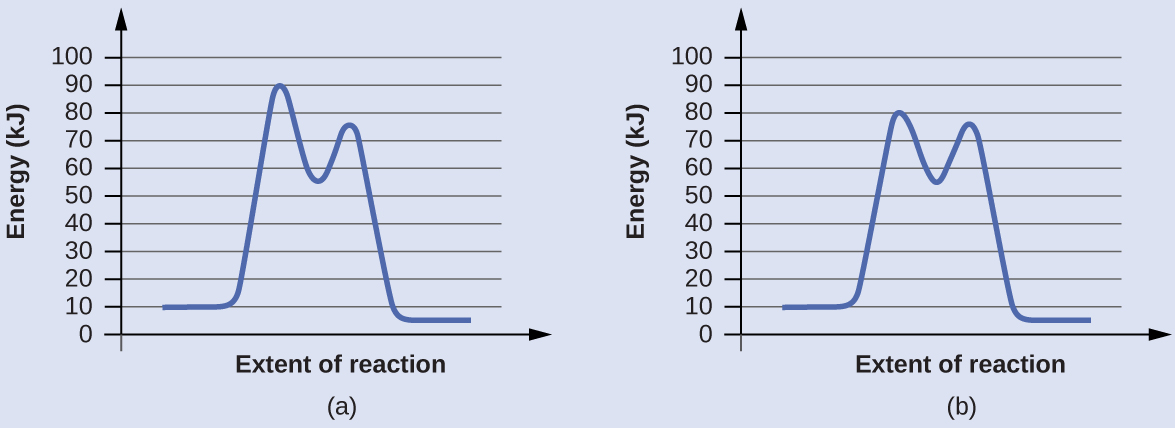
Reaction diagrams for a chemical process with and without a catalyst are shown below. Both reactions involve a two-step mechanism with a rate-determining first step. Compute activation energies for the first step of each mechanism, and identify which corresponds to the catalyzed reaction. How do the second steps of these two mechanisms compare? In this figure, two graphs are shown. The x-axes are labeled, “Extent of reaction,” and the y-axes are labeledc “Energy (k J).” The y-axes are marked off from 0 to 100 at intervals of 10. In a, a blue curve is shown. It begins with a horizontal segment at about 10. The curve then rises sharply near the middle to reach a maximum of about 91, then sharply falls to about 52, again rises sharply to about 73 and falls to another horizontal segment at about 5. In b, the curve begins and ends similarly, but the first peak reaches about 81, drops to about 55, then rises to about 77 before falling to the horizontal region at about 5.

Answer

For the first step, Ea = 80 kJ for (a) and 70 kJ for (b), so diagram (b) depicts the catalyzed reaction. Activation energies for the second steps of both mechanisms are the same, 20 kJ.

17-1 §17.1 source ↗

What is the difference between average rate, initial rate, and instantaneous rate?

Answer

The instantaneous rate is the rate of a reaction at any particular point in time, a period of time that is so short that the concentrations of reactants and products change by a negligible amount. The initial rate is the instantaneous rate of reaction as it starts (as product just begins to form). Average rate is the average of the instantaneous rates over a time period.

17-3 §17.1 source ↗

In the nuclear industry, chlorine trifluoride is used to prepare uranium hexafluoride, a volatile compound of uranium used in the separation of uranium isotopes. Chlorine trifluoride is prepared by the reaction Cl2(g)+ 3F2(g)⟶ 2ClF3(g). Write the equation that relates the rate expressions for this reaction in terms of the disappearance of Cl2 and F2 and the formation of ClF3.

Answer

rate= + 1 2 Δ [ CIF 3 ] Δ t = − Δ [ Cl 2 ] Δ t = − 1 3 Δ [ F 2 ] Δ t

17-5 §17.1 source ↗

A study of the rate of the reaction represented as 2A⟶B gave the following data:

Time (s) 0.0 5.0 10.0 15.0 20.0 25.0 35.0
[A] (M) 1.00 0.775 0.625 0.465 0.360 0.285 0.230

(a) Determine the average rate of disappearance of A between 0.0 s and 10.0 s, and between 10.0 s and 20.0 s.

(b) Estimate the instantaneous rate of disappearance of A at 15.0 s from a graph of time versus [A]. What are the units of this rate?

(c) Use the rates found in parts (a) and (b) to determine the average rate of formation of B between 0.00 s and 10.0 s, and the instantaneous rate of formation of B at 15.0 s.

Answer

(a) average rate, 0 − 10 s = 0.0375 mol L−1 s−1; average rate, 10 − 20 s = 0.0265 mol L−1 s−1; (b) instantaneous rate, 15 s = 0.023 mol L−1 s−1; (c) average rate for B formation = 0.0188 mol L−1 s−1; instantaneous rate for B formation = 0.012 mol L−1 s−1

17-7 §17.2 source ↗

Describe the effect of each of the following on the rate of the reaction of magnesium metal with a solution of hydrochloric acid: the molarity of the hydrochloric acid, the temperature of the solution, and the size of the pieces of magnesium.

Answer

Higher molarity increases the rate of the reaction. Higher temperature increases the rate of the reaction. Smaller pieces of magnesium metal will react more rapidly than larger pieces because more reactive surface exists.

17-9 §17.2 source ↗

Go to the PhET Reactions & Rates interactive. Use the Single Collision tab to represent how the collision between monatomic oxygen (O) and carbon monoxide (CO) results in the breaking of one bond and the formation of another. Pull back on the red plunger to release the atom and observe the results. Then, click on “Reload Launcher” and change to “Angled shot” to see the difference.

(a) What happens when the angle of the collision is changed?

(b) Explain how this is relevant to rate of reaction.

Answer

(a) Depending on the angle selected, the atom may take a long time to collide with the molecule and, when a collision does occur, it may not result in the breaking of the bond and the forming of the other. (b) Particles of reactant must come into contact with each other before they can react.

17-11 §17.2 source ↗

In the PhET Reactions & Rates interactive, on the Many Collisions tab, set up a simulation with 15 molecules of A and 10 molecules of BC. Select “Show Bonds” under Options.

(a) Leave the Initial Temperature at the default setting. Observe the reaction. Is the rate of reaction fast or slow?

(b) Click “Pause” and then “Reset All,” and then enter 15 molecules of A and 10 molecules of BC once again. Select “Show Bonds” under Options. This time, increase the initial temperature until, on the graph, the total average energy line is completely above the potential energy curve. Describe what happens to the reaction.

Answer

(a) very slow; (b) As the temperature is increased, the reaction proceeds at a faster rate. The amount of reactants decreases, and the amount of products increases. After a while, there is a roughly equal amount of BC, AB, and C in the mixture and a slight excess of A.

17-13 §17.3 source ↗

Doubling the concentration of a reactant increases the rate of a reaction four times. With this knowledge, answer the following questions:

(a) What is the order of the reaction with respect to that reactant?

(b) Tripling the concentration of a different reactant increases the rate of a reaction three times. What is the order of the reaction with respect to that reactant?

Answer

(a) 2; (b) 1

17-15 §17.3 source ↗

How will the rate of reaction change for the process: CO(g)+ NO2(g)⟶ CO2(g)+ NO(g) if the rate law for the reaction is rate= k[NO2]2?

(a) Decreasing the pressure of NO2 from 0.50 atm to 0.250 atm.

(b) Increasing the concentration of CO from 0.01 M to 0.03 M.

Answer

(a) The process reduces the rate by a factor of 4. (b) Since CO does not appear in the rate law, the rate is not affected.

17-17 §17.3 source ↗

Regular flights of supersonic aircraft in the stratosphere are of concern because such aircraft produce nitric oxide, NO, as a byproduct in the exhaust of their engines. Nitric oxide reacts with ozone, and it has been suggested that this could contribute to depletion of the ozone layer. The reaction NO+ O3⟶ NO2+ O2 is first order with respect to both NO and O3 with a rate constant of 2.20 × 10⁷ L/mol/s. What is the instantaneous rate of disappearance of NO when [NO] = 3.3 × 10⁻⁶ M and [O3] = 5.9 × 10⁻⁷ M?

Answer

4.3 × 10⁻⁵ mol/L/s

17-19 §17.3 source ↗

The rate constant for the radioactive decay of 14C is 1.21 × 10⁻⁴ year−1. The products of the decay are nitrogen atoms and electrons (beta particles):
614C⟶ 714N+ e−
rate= k[614C]

What is the instantaneous rate of production of N atoms in a sample with a carbon-14 content of 6.5 × 10⁻⁹ M?

Answer

7.9 × 10⁻¹³ mol/L/year

17-21 §17.3 source ↗

Alcohol is removed from the bloodstream by a series of metabolic reactions. The first reaction produces acetaldehyde; then other products are formed. The following data have been determined for the rate at which alcohol is removed from the blood of an average male, although individual rates can vary by 25–30%. Women metabolize alcohol a little more slowly than men:

[C2H5OH] (M) 4.4 × 10⁻² 3.3 × 10⁻² 2.2 × 10⁻²
Rate (mol L−1 h−1) 2.0 × 10⁻² 2.0 × 10⁻² 2.0 × 10⁻²

Determine the rate law, the rate constant, and the overall order for this reaction.

Answer

rate = k; k = 2.0 × 10⁻² mol L−1 h−1 (about 0.9 g L−1 h−1 for the average male); The reaction is zero order.

17-23 §17.3 source ↗

Nitrosyl chloride, NOCl, decomposes to NO and Cl2.
2NOCl(g)⟶ 2NO(g)+ Cl2(g)

Determine the rate law, the rate constant, and the overall order for this reaction from the following data:

[NOCl] (M) 0.10 0.20 0.30
Rate (mol L−1 h−1) 8.0 × 10⁻¹⁰ 3.2 × 10⁻⁹ 7.2 × 10⁻⁹

Answer

rate = k[NOCl]2; k = 8.0 × 10⁻⁸ L/mol/h; second order

17-25 §17.3 source ↗

Nitrogen monoxide reacts with chlorine according to the equation:
2NO(g)+ Cl2(g)⟶ 2NOCl(g)

The following initial rates of reaction have been observed for certain reactant concentrations:

[NO] (mol/L) [Cl2] (mol/L) Rate (mol L−1 h−1)
0.50 0.50 1.14
1.00 0.50 4.56
1.00 1.00 9.12

What is the rate law that describes the rate’s dependence on the concentrations of NO and Cl2? What is the rate constant? What are the orders with respect to each reactant?

Answer

rate = k[NO]2[Cl2]; k = 9.1 L2 mol−2 h−1; second order in NO; first order in Cl2

17-27 §17.3 source ↗

For the reaction A⟶B+C, the following data were obtained at 30 °C:

[A] (M) 0.230 0.356 0.557
Rate (mol L−1 s−1) 4.17 × 10⁻⁴ 9.99 × 10⁻⁴ 2.44 × 10⁻³

(a) What is the order of the reaction with respect to [A], and what is the rate law?

(b) What is the rate constant?

Answer

(a) The rate law is second order in A and is written as rate = k[A]2. (b) k = 7.88 × 10⁻³ L mol−1 s−1

17-29 §17.3 source ↗

The rate constant for the first-order decomposition at 45 °C of dinitrogen pentoxide, N2O5, dissolved in chloroform, CHCl3, is 6.2 × 10⁻⁴ min−1.
2N2O5⟶ 4NO2+ O2

What is the rate of the reaction when [N2O5] = 0.40 M?

Answer

(a) 2.5 × 10⁻⁴ mol/L/min

17-31 §17.3 source ↗

The following data have been determined for the reaction:
I−+ OCl−⟶ IO−+ Cl−

1 2 3
[I−]initial (M) 0.10 0.20 0.30
[OCl−]initial (M) 0.050 0.050 0.010
Rate (mol L−1 s−1) 3.05 × 10⁻⁴ 6.20 × 10⁻⁴ 1.83 × 10⁻⁴

Determine the rate law and the rate constant for this reaction.

Answer

rate = k[I−][OCl−]; k = 6.1 × 10⁻² L mol −1 s−1

17-33 §17.4 source ↗

Use the data provided to graphically determine the order and rate constant of the following reaction: SO2Cl2⟶ SO2+ Cl2

Time (s) 0 5.00 × 10³ 1.00 × 10⁴ 1.50 × 10⁴
[SO2Cl2] (M) 0.100 0.0896 0.0802 0.0719
Time (s) 2.50 × 10⁴ 3.00 × 10⁴ 4.00 × 10⁴
[SO2Cl2] (M) 0.0577 0.0517 0.0415

Answer

Plotting a graph of ln[SO2Cl2] versus t reveals a linear trend; therefore we know this is a first-order reaction:
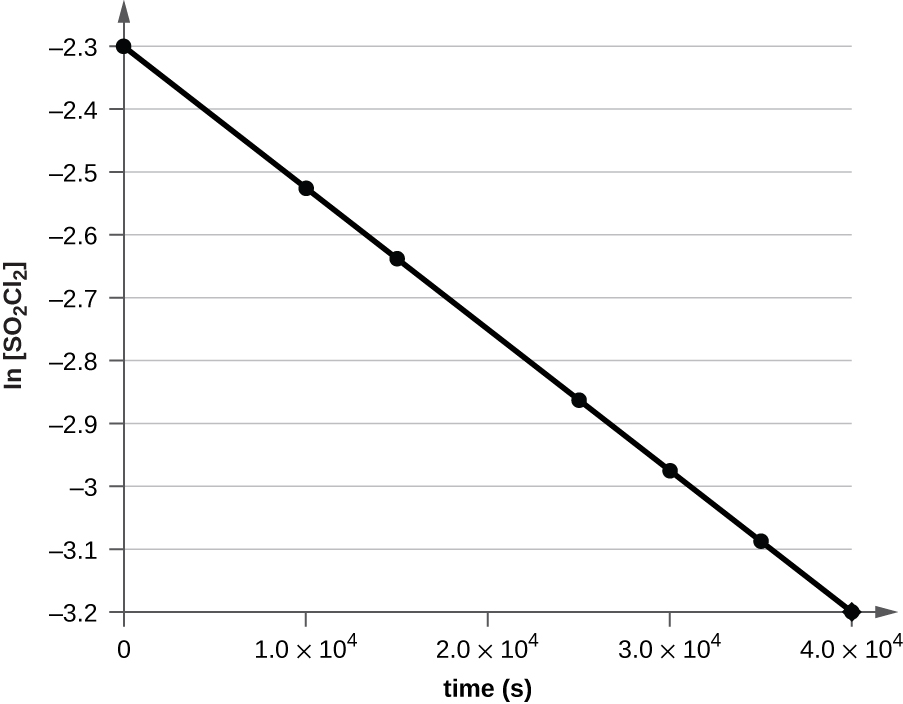
A graph is shown with the label “Time ( s )” on the x-axis and “l n [ S O subscript 2 C l subscript 2 ] M” on the y-axis. The x-axis begins at 0 and extends to 4.00 times 10 superscript 4 with markings every 1.00 times 10 superscript 4. The y-axis shows markings extending from negative 3.5 to negative 2.5. A decreasing linear trend line is drawn through seven points at the approximate coordinates: (0, negative 2.3), (0.5 times 10 superscript 4, negative 2.4), (1.0 times 10 superscript 4, negative 2.5), (1.5 times 10 superscript 4, negative 2.6), (2.0 times 10 superscript 4, negative 2.9), (2.5 times 10 superscript 4, negative 3.0), and (3.0 times 10 superscript 4, negative 3.2).


k = 2.20 × 10⁻⁵ s−1

17-34 §17.4 source ↗

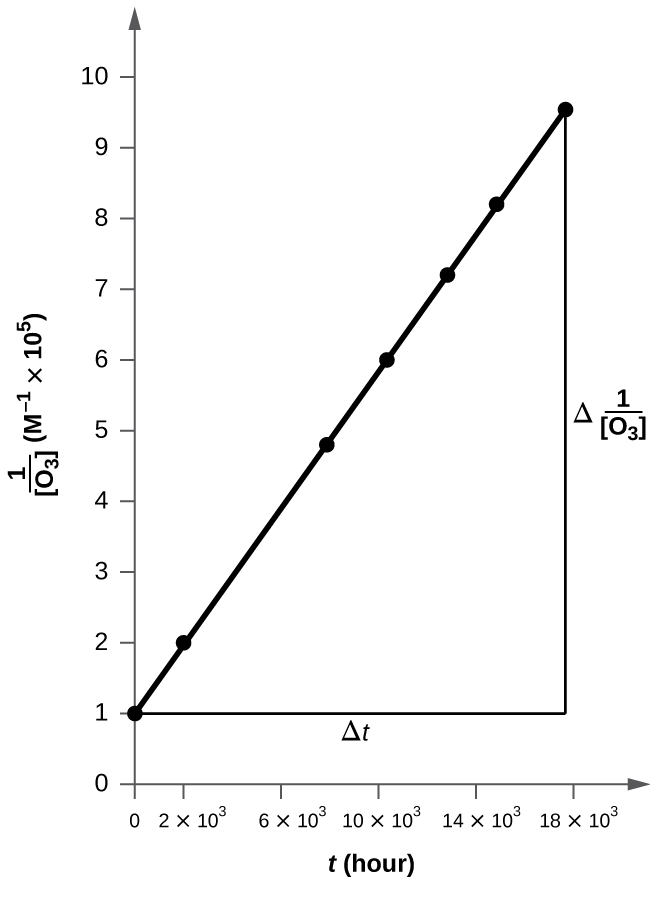
Pure ozone decomposes slowly to oxygen, 2O3(g)⟶ 3O2(g). Use the data provided in a graphical method and determine the order and rate constant of the reaction.

Time (h) 0 2.0 × 10³ 7.6 × 10³ 1.00 × 10⁴
[O3] (M) 1.00 × 10⁻⁵ 4.98 × 10⁻⁶ 2.07 × 10⁻⁶ 1.66 × 10⁻⁶
Time (h) 1.23 × 10⁴ 1.43 × 10⁴ 1.70 × 10⁴
[O3] (M) 1.39 × 10⁻⁶ 1.22 × 10⁻⁶ 1.05 × 10⁻⁶

Answer

A graph is shown with the label, “t ( h ,)” on the x-axis and, “1 divided by [ O subscript 3 ] M,” on the y-axis. The x-axis shows markings at 0, 2 times 10 superscript 3, 6 times 10 superscript 3, 10 time 10 superscript 3, 14 times 10 superscript 3, and 18 times 10 superscript 3. The y-axis shows markings beginning at 0, increasing by 1 up to and including 9. An increasing linear trend line is drawn through seven points at the coordinates: (0, 1.00), (2.0 times 10 superscript 3, 2.01), (7.6 times 10 superscript 3, 4.83), (1.00 times 10 superscript 4, 6.02), (1.23 times 10 superscript 4 , 6.02), (1.43 times 10 superscript 4, 8.20) and (1.70 times 10 superscript 4, 9.52). A horizontal line segment is drawn through the first point and a vertical line segment is similarly drawn through the last point to make a right triangle on the graph. The horizontal leg of the triangle is labeled “ capital delta t.” The vertical leg is labeled “capital delta 1 divided by [ O subscript 3 ].”


The plot is nicely linear, so the reaction is second order. k = 50.1 L mol−1 h−1

17-36 §17.4 source ↗

What is the half-life for the first-order decay of phosphorus-32? ( 1532P ⟶ 1632S +e−) The rate constant for the decay is 4.85 × 10⁻² day−1.

Answer

14.3 d

17-38 §17.4 source ↗

What is the half-life for the decomposition of NOCl when the concentration of NOCl is 0.15 M? The rate constant for this second-order reaction is 8.0 × 10⁻⁸ L mol−1 s−1.

Answer

8.3 × 10⁷ s

17-40 §17.4 source ↗

The reaction of compound  A to give compounds  C and  D was found to be second-order in  A. The rate constant for the reaction was determined to be 2.42 L mol−1 s−1. If the initial concentration is 0.500 mol/L, what is the value of t1/2?

Answer

0.826 s

17-42 §17.4 source ↗

Some bacteria are resistant to the antibiotic penicillin because they produce penicillinase, an enzyme with a molecular weight of 3 × 10⁴ g/mol that converts penicillin into inactive molecules. Although the kinetics of enzyme-catalyzed reactions can be complex, at low concentrations this reaction can be described by a rate law that is first order in the catalyst (penicillinase) and that also involves the concentration of penicillin. From the following data: 1.0 L of a solution containing 0.15 µg (0.15 × 10⁻⁶ g) of penicillinase, determine the order of the reaction with respect to penicillin and the value of the rate constant.

[Penicillin] (M) Rate (mol L−1 min−1)
2.0 × 10⁻⁶ 1.0 × 10⁻¹⁰
3.0 × 10⁻⁶ 1.5 × 10⁻¹⁰
4.0 × 10⁻⁶ 2.0 × 10⁻¹⁰

Answer

The reaction is first order. k = 1.0 × 10⁷ L mol−1 min−1

17-44 §17.4 source ↗

There are two molecules with the formula C3H6. Propene, CH3CH=CH2, is the monomer of the polymer polypropylene, which is used for indoor-outdoor carpets. Cyclopropane is used as an anesthetic:
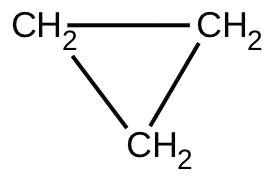
A structural formula for cyclopropane is shown. Three C H subscript 2 groups are positioned as vertices of an equilateral triangle connected with single bonds represented by line segments.

When heated to 499 °C, cyclopropane rearranges (isomerizes) and forms propene with a rate constant of
5.95 × 10⁻⁴ s−1. What is the half-life of this reaction? What fraction of the cyclopropane remains after 0.75 h at 499 °C?

Answer

1.16 × 10³ s ; 20% remains

17-46 §17.4 source ↗

Suppose that the half-life of steroids taken by an athlete is 42 days. Assuming that the steroids biodegrade by a first-order process, how long would it take for 164 of the initial dose to remain in the athlete’s body?

Answer

252 days

17-48 §17.4 source ↗

Nitroglycerine is an extremely sensitive explosive. In a series of carefully controlled experiments, samples of the explosive were heated to 160 °C and their first-order decomposition studied. Determine the average rate constants for each experiment using the following data:

Initial [C3H5N3O9] (M) 4.88 3.52 2.29 1.81 5.33 4.05 2.95 1.72
t (s) 300 300 300 300 180 180 180 180
% Decomposed 52.0 52.9 53.2 53.9 34.6 35.9 36.0 35.4

Answer

[A]0 (M) k × 103 (s−1)
4.88 2.45
3.52 2.51
2.29 2.53
1.81 2.58
5.33 2.36
4.05 2.47
2.95 2.48
1.72 2.43

17-50 §17.5 source ↗

Chemical reactions occur when reactants collide. What are two factors that may prevent a collision from producing a chemical reaction?

Answer

The reactants either may be moving too slowly to have enough kinetic energy to exceed the activation energy for the reaction, or the orientation of the molecules when they collide may prevent the reaction from occurring.

17-52 §17.5 source ↗

What is the activation energy of a reaction, and how is this energy related to the activated complex of the reaction?

Answer

The activation energy is the minimum amount of energy necessary to form the activated complex in a reaction. It is usually expressed as the energy necessary to form one mole of activated complex.

17-54 §17.5 source ↗

Describe how graphical methods can be used to determine the activation energy of a reaction from a series of data that includes the rate of reaction at varying temperatures.

Answer

After finding k at several different temperatures, a plot of ln k versus 1T, gives a straight line with the slope −EaR from which Ea may be determined.

17-56 §17.5 source ↗

The rate of a certain reaction doubles for every 10 °C rise in temperature.

(a) How much faster does the reaction proceed at 45 °C than at 25 °C?

(b) How much faster does the reaction proceed at 95 °C than at 25 °C?

Answer

(a) 4-times faster (b) 128-times faster

17-58 §17.5 source ↗

The rate constant at 325 °C for the decomposition reaction C4H8⟶2C2H4 is 6.1 × 10⁻⁸ s−1, and the activation energy is 261 kJ per mole of C4H8. Determine the frequency factor for the reaction.

Answer

3.9 × 10 15 s −1

17-60 §17.5 source ↗

An elevated level of the enzyme alkaline phosphatase (ALP) in human serum is an indication of possible liver or bone disorder. The level of serum ALP is so low that it is very difficult to measure directly. However, ALP catalyzes a number of reactions, and its relative concentration can be determined by measuring the rate of one of these reactions under controlled conditions. One such reaction is the conversion of p-nitrophenyl phosphate (PNPP) to p-nitrophenoxide ion (PNP) and phosphate ion. Control of temperature during the test is very important; the rate of the reaction increases 1.47 times if the temperature changes from 30 °C to 37 °C. What is the activation energy for the ALP–catalyzed conversion of PNPP to PNP and phosphate?

Answer

43.0 kJ/mol

17-62 §17.5 source ↗

Hydrogen iodide, HI, decomposes in the gas phase to produce hydrogen, H2, and iodine, I2. The value of the rate constant, k, for the reaction was measured at several different temperatures and the data are shown here:

Temperature (K) k (L mol−1 s−1)
555 6.23 × 10⁻⁷
575 2.42 × 10⁻⁶
645 1.44 × 10⁻⁴
700 2.01 × 10⁻³

What is the value of the activation energy (in kJ/mol) for this reaction?

Answer

177 kJ/mol

17-64 §17.5 source ↗

The hydrolysis of the sugar sucrose to the sugars glucose and fructose,
C12H22O11+ H2O⟶ C6H12O6+ C6H12O6

follows a first-order rate law for the disappearance of sucrose: rate = k[C12H22O11] (The products of the reaction, glucose and fructose, have the same molecular formulas but differ in the arrangement of the atoms in their molecules.)

(a) In neutral solution, k = 2.1 × 10⁻¹¹ s−1 at 27 °C and 8.5 × 10⁻¹¹ s−1 at 37 °C. Determine the activation energy, the frequency factor, and the rate constant for this equation at 47 °C (assuming the kinetics remain consistent with the Arrhenius equation at this temperature).

(b) When a solution of sucrose with an initial concentration of 0.150 M reaches equilibrium, the concentration of sucrose is 1.65 × 10⁻⁷ M. How long will it take the solution to reach equilibrium at 27 °C in the absence of a catalyst? Because the concentration of sucrose at equilibrium is so low, assume that the reaction is irreversible.

(c) Why does assuming that the reaction is irreversible simplify the calculation in part (b)?

Answer

Ea = 108 kJ; A = 2.0 × 10⁸ s−1; k = 3.2 × 10⁻¹⁰ s−1; (b) 1.81 × 10⁸ h or 7.6 × 10⁶ day; (c) Assuming that the reaction is irreversible simplifies the calculation because we do not have to account for any reactant that, having been converted to product, returns to the original state.

17-66 §17.5 source ↗

Use the PhET Reactions & Rates interactive simulation to simulate a system. On the “Single collision” tab of the simulation applet, enable the “Energy view” by clicking the “+” icon. Select the first A+BC⟶AB+C reaction (A is yellow, B is purple, and C is navy blue). Using the “angled shot” option, try launching the A atom with varying angles, but with more Total energy than the transition state. What happens when the A atom hits the BC molecule from different directions? Why?

Answer

The A atom has enough energy to react with BC; however, the different angles at which it bounces off of BC without reacting indicate that the orientation of the molecule is an important part of the reaction kinetics and determines whether a reaction will occur.

17-68 §17.6 source ↗

In general, can we predict the effect of doubling the concentration of A on the rate of the overall reaction A+B⟶C? Can we predict the effect if the reaction is known to be an elementary reaction?

Answer

No. In general, for the overall reaction, we cannot predict the effect of changing the concentration without knowing the rate law. Yes. If the reaction is an elementary reaction, then doubling the concentration of A doubles the rate.

17-70 §17.6 source ↗

What is the rate law for the elementary termolecular reaction A+ 2B⟶ products? For 3A⟶ products?

Answer

Rate = k[A][B]2; Rate = k[A]3

17-72 §17.6 source ↗

Write the rate law for each of the following elementary reactions:

(a) O3→sunlightO2+ O

(b) O3+ Cl⟶ O2+ ClO

(c) ClO+O⟶Cl+O2

(d) O3+ NO⟶ NO2+ O2

(e) NO2+O⟶NO+O2

Answer

(a) Rate1 = k[O3]; (b) Rate2 = k[O3][Cl]; (c) Rate3 = k[ClO][O]; (d) Rate2 = k[O3][NO]; (e) Rate3 = k[NO2][O]

17-74 §17.6 source ↗

Experiments were conducted to study the rate of the reaction represented by this equation.3
2NO(g)+ 2H2(g)⟶ N2(g)+ 2H2O(g)

Initial concentrations and rates of reaction are given here.

Experiment Initial Concentration [NO] (mol L−1) Initial Concentration, [H2] (mol L−1) Initial Rate of Formation of N2 (mol L−1 min−1)
1 0.0060 0.0010 1.8 × 10⁻⁴
2 0.0060 0.0020 3.6 × 10⁻⁴
3 0.0010 0.0060 0.30 × 10⁻⁴
4 0.0020 0.0060 1.2 × 10⁻⁴

Consider the following questions:

(a) Determine the order for each of the reactants, NO and H2, from the data given and show your reasoning.

(b) Write the overall rate law for the reaction.

(c) Calculate the value of the rate constant, k, for the reaction. Include units.

(d) For experiment 2, calculate the concentration of NO remaining when exactly one-half of the original amount of H2 had been consumed.

(e) The following sequence of elementary steps is a proposed mechanism for the reaction.

Step 1: NO+NO⇌N2O2

Step 2: N2O2+ H2⇌ H2O+ N2O

Step 3: N2O+ H2⇌ N2+ H2O

Based on the data presented, which of these is the rate determining step? Show that the mechanism is consistent with the observed rate law for the reaction and the overall stoichiometry of the reaction.

Answer

(a) Doubling [H2] doubles the rate. [H2] must enter the rate law to the first power. Doubling [NO] increases the rate by a factor of 4. [NO] must enter the rate law to the second power. (b) Rate = k [NO]2[H2]; (c) k = 5.0 × 10³ mol2 L−2 min−1; (d) 0.0050 mol/L; (e) Step II is the rate-determining step. If step I gives N2O2 in adequate amount, steps 1 and 2 combine to give 2NO+ H2⟶ H2O+ N2O. This reaction corresponds to the observed rate law. Combine steps 1 and 2 with step 3, which occurs by supposition in a rapid fashion, to give the appropriate stoichiometry.

17-76 §17.7 source ↗

Account for the increase in reaction rate brought about by a catalyst.

Answer

The general mode of action for a catalyst is to provide a mechanism by which the reactants can unite more readily by taking a path with a lower reaction energy. The rates of both the forward and the reverse reactions are increased, leading to a faster achievement of equilibrium.

17-78 §17.7 source ↗

Consider this scenario and answer the following questions: Chlorine atoms resulting from decomposition of chlorofluoromethanes, such as CCl2F2, catalyze the decomposition of ozone in the atmosphere. One simplified mechanism for the decomposition is:
O3→sunlightO2+OO3+Cl⟶O2+ClOClO+O⟶Cl+O2

(a) Explain why chlorine atoms are catalysts in the gas-phase transformation:
2O3⟶3O2

(b) Nitric oxide is also involved in the decomposition of ozone by the mechanism:
O3→sunlightO2+OO3+NO⟶NO2+O2NO2+O⟶NO+O2

Is NO a catalyst for the decomposition? Explain your answer.

Answer

(a) Chlorine atoms are a catalyst because they react in the second step but are regenerated in the third step. Thus, they are not used up, which is a characteristic of catalysts. (b) NO is a catalyst for the same reason as in part (a).

17-79 §17.7 source ↗

Water gas is a 1:1 mixture of carbon monoxide and hydrogen gas and is called water gas because it is formed from steam and hot carbon in the following reaction: H2O(g)+ C(s)⇌ H2(g)+ CO(g). Methanol, a liquid fuel that could possibly replace gasoline, can be prepared from water gas and hydrogen at high temperature and pressure in the presence of a suitable catalyst. What will happen to the concentrations of H2, CO, and CH3OH at equilibrium if more catalyst is added?

Answer

no changes.

17-82 §17.7 source ↗

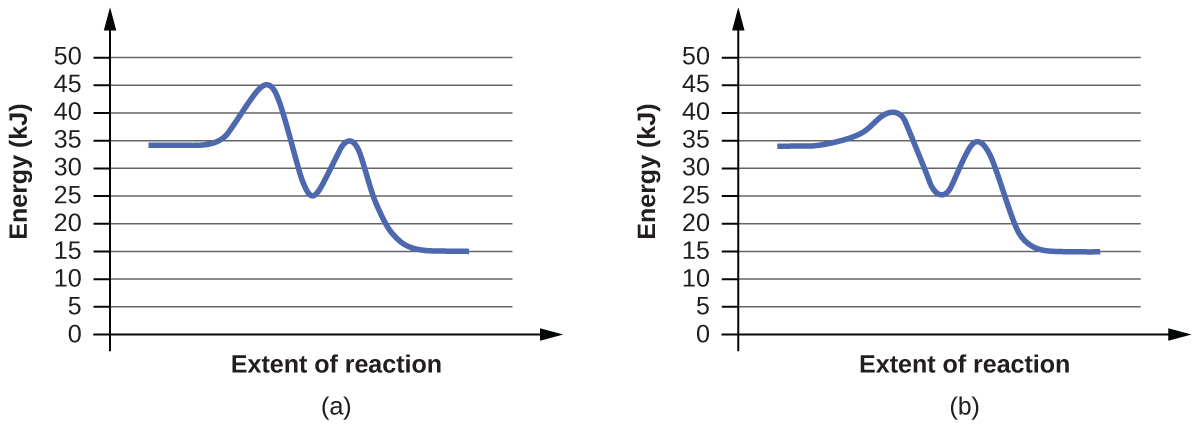
For each of the following pairs of reaction diagrams, identify which of the pairs is catalyzed:

(a)
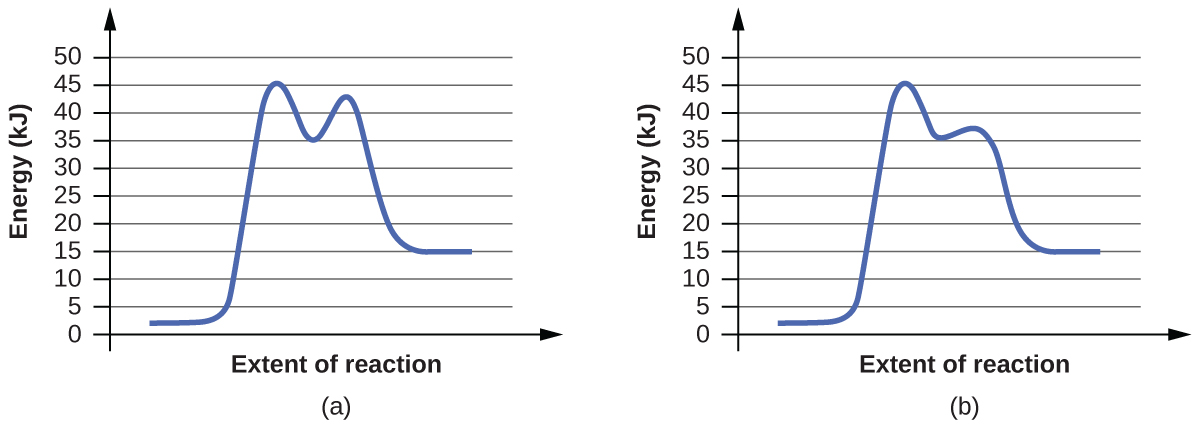
In this figure, two graphs are shown. The x-axes are labeled, “Extent of reaction” and the y-axes are labeled, “Energy (k J).” The y-axes are marked off from 0 to 50 at intervals of 5. In a, a blue curve is shown. It begins with a horizontal segment at about 2J. The curve then rises sharply near the middle to reach a maximum of about 46, then sharply falls to about 35, again rises to about 38 and falls to another horizontal segment at about 15. In b, the curve begins and ends similarly, but the first peak reaches about 46, drops to about 35, then rises to about 43 before falling to the horizontal region at about 15.

(b)

In this figure, two graphs are shown. The x-axes are labeled, “Extent of reaction,” and the y-axes are labeled, “Energy (k J).” The y-axes are marked off from 0 to 50 at intervals of 5. In a, a blue curve is shown. It begins with a horizontal segment at about 34. The curve then rises sharply near the middle to reach a maximum of about 45, then sharply falls to about 25, again rises sharply to about 35 and falls to another horizontal segment at about 15. In b, the curve begins and ends similarly, but the first peak reaches about 40, drops to 25, then rises to 35 before falling to the horizontal region at about 15.

Answer

The lowering of the transition state energy indicates the effect of a catalyst. (a) B; (b) B

17-84 §17.7 source ↗

For each of the following reaction diagrams, estimate the activation energy (Ea) of the reaction:

(a)
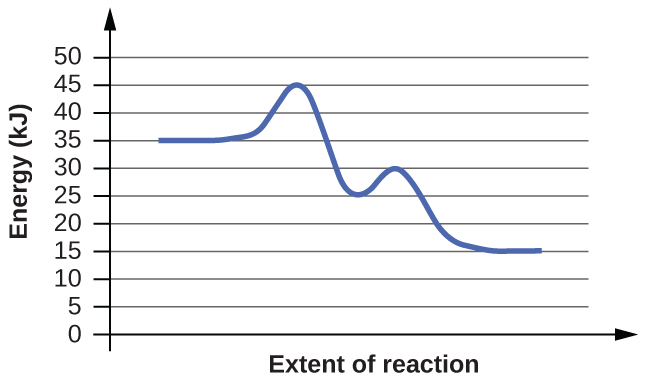
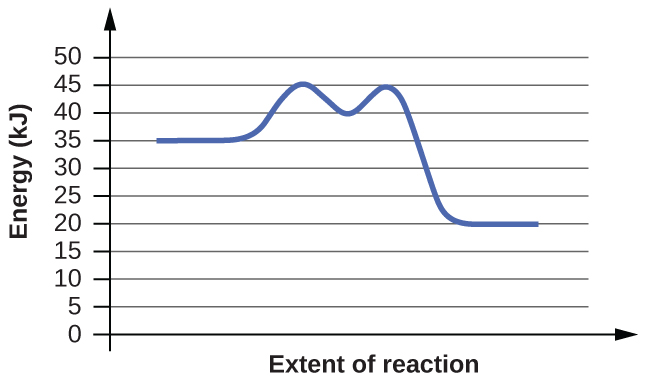
In this figure, a graph is shown. The x-axis is labeled, “Extent of reaction,” and the y-axis is labeled, “Energy (k J).” A blue curve is shown. It begins with a horizontal segment at about 35. The curve then rises sharply near the middle to reach a maximum of about 45, then sharply falls to about 24, again rises to about 30 and falls to another horizontal segment at about 15.

(b)

In this figure, a graph is shown. The x-axis is labeled, “Extent of reaction,” and the y-axis is labeled, “Energy (k J).” A blue curve is shown. It begins with a horizontal segment at about 35. The curve then rises sharply near the middle to reach a maximum of about 45, then sharply falls to about 40, again rises to about 45 and falls to another horizontal segment at about 20.

Answer

The energy needed to go from the initial state to the transition state is (a) 10 kJ; (b) 10 kJ

17-86 §17.7 source ↗

Consider the similarities and differences in the two reaction diagrams shown in Exercise 17.84. Do these diagrams represent two different overall reactions, or do they represent the same overall reaction taking place by two different mechanisms? Explain your answer.

Answer

Both diagrams describe two-step, exothermic reactions, but with different changes in enthalpy, suggesting the diagrams depict two different overall reactions.

Loading chapter 18…

Problems and answers are adapted from Chemistry: Atoms First 2e by Paul Flowers, Edward J. Neth, William R. Robinson, Klaus Theopold and Richard Langley, OpenStax, and are used under the CC BY-NC-SA 4.0 licence. Access for free at https://openstax.org/books/chemistry-atoms-first-2e/pages/1-introduction. Illustrations: Copyright Rice University, OpenStax, under CC BY-NC-SA 4.0 license. This adaptation is released under the same licence, is non-commercial, and is neither affiliated with nor endorsed by OpenStax or Rice University.