Every problem in the chapter beside the book’s answer, a chapter at a time as you scroll.

Chapter 5: Advanced Theories of Bonding

31 problems · 20 figures

Example 5.1 §5.1 source ↗

Identify each illustration as depicting a σ or π bond:

(a) side-by-side overlap of a 4p and a 2p orbital

(b) end-to-end overlap of a 4p and 4p orbital

(c) end-to-end overlap of a 4p and a 2p orbital

Three diagrams are shown and labeled “a,” “b,” and “c.” Diagram a depicts two peanut-shaped orbitals lying vertically side-by-side and overlapping. One orbital is smaller than the other. Diagram b shows two peanut-shaped orbitals lying end-to-end and overlapping. Diagram c shows two unequally sized peanut-shaped orbitals lying end-to-end and overlapping.

Answer

(a) is a π bond with a node along the axis connecting the nuclei while (b) and (c) are σ bonds that overlap along the axis.

Example 5.3 §5.2 source ↗

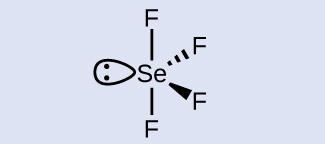
What is the hybridization of the selenium atom in SeF4? A Lewis structure is shown in which four fluorine atoms are each attached to one sulfur atom. Two of the attached fluorine atoms are vertically attached up and down, while two are attached into and out of the page to the right. The sulfur also has one lone pair of electrons attached to the left of the structure.

Answer

The selenium atom is sp3d hybridized.

Example 5.4 §5.2 source ↗

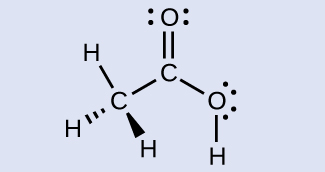
Acetic acid, H3CC(O)OH, is the molecule that gives vinegar its odor and sour taste. What is the hybridization of the two carbon atoms in acetic acid? A Lewis structure is shown in which a carbon atom is double bonded to an oxygen atom that has two lone pairs of electrons and single bonded to another oxygen atom that is single boned to a hydrogen atom. This second oxygen atom has two lone pairs of electrons. The carbon is also single bonded to a carbon atom that is single bonded to three hydrogen atoms.

Answer

H3C, sp3; C(O)OH, sp2

Example 5.5 §5.3 source ↗

Another acid in acid rain is nitric acid, HNO3, which is produced by the reaction of nitrogen dioxide, NO2, with atmospheric water vapor. What is the hybridization of the nitrogen atom in NO2? (Note: the lone electron on nitrogen occupies a hybridized orbital just as a lone pair would.)

Answer

sp2

Example 5.6 §5.4 source ↗

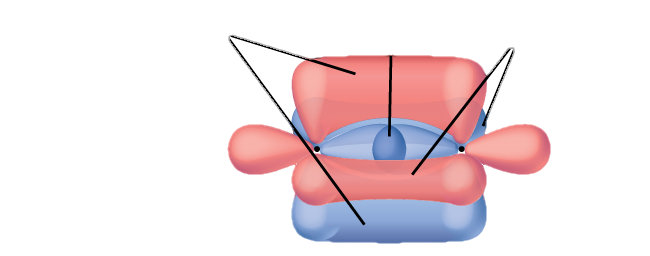
Label the molecular orbital shown as σ or π, bonding or antibonding and indicate where the node occurs. Two orbitals are shown lying end-to-end. Each has one enlarged and one small side. The small sides are facing one another

Answer

The orbital is located along the internuclear axis, so it is a σ orbital. There is a node bisecting the internuclear axis, so it is an antibonding orbital.

Two orbitals are shown lying end-to-end. Each has one enlarged and one small side. The small sides are facing one another and are separated by a vertical dotted line.

Example 5.7 §5.4 source ↗

The main component of air is N2. From the molecular orbital diagram of N2, predict its bond order and whether it is diamagnetic or paramagnetic.

Answer

N2 has a bond order of 3 and is diamagnetic.

Example 5.8 §5.4 source ↗

How many unpaired electrons would be present on a Be22− ion? Would it be paramagnetic or diamagnetic?

Answer

two, paramagnetic

5-1 §5.1 source ↗

Explain how σ and π bonds are similar and how they are different.

Answer

Similarities: Both types of bonds result from overlap of atomic orbitals on adjacent atoms and contain a maximum of two electrons. Differences: σ bonds are stronger and result from end-to-end overlap and all single bonds are σ bonds; π bonds between the same two atoms are weaker because they result from side-by-side overlap, and multiple bonds contain one or more π bonds (in addition to a σ bond).

5-3 §5.1 source ↗

Use valence bond theory to explain the bonding in O2. Sketch the overlap of the atomic orbitals involved in the bonds in O2.

Answer

Bonding: One σ bond and one π bond. The s orbitals are filled and do not overlap. The p orbitals overlap along the axis to form a σ bond and side-by-side to form the π bond.
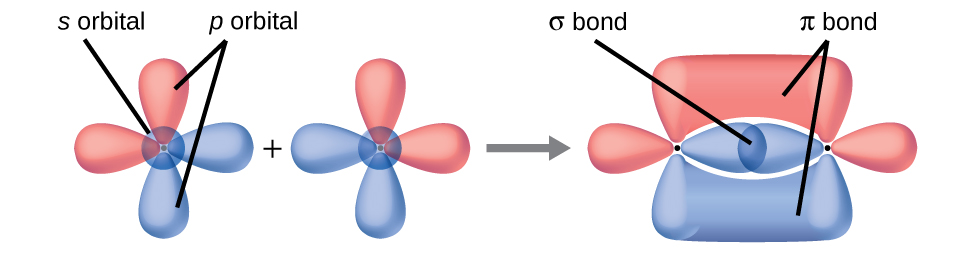
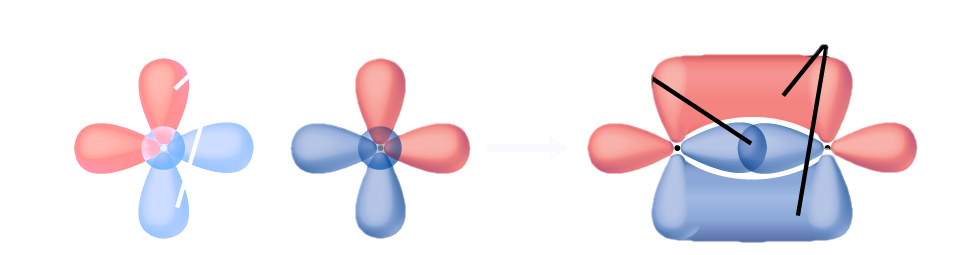
This figure shows the orbitals of two atoms being added together as they form bonds. The two atoms are shown separately on the right, each having two peanut-shaped orbitals lying perpendicularly to one another. A right-facing arrow shows that the two have moved closer together and now the upper and lower portions of the vertical peanut-shaped orbitals are shown as merging together above and below the plane of the molecule while the horizontal peanut-shaped orbitals are overlapping between the two nuclei.This figure shows the orbitals of two atoms being added together as they form bonds. The two atoms are shown separately on the right, each having two peanut-shaped orbitals lying perpendicularly to one another. A right-facing arrow shows that the two have moved closer together and now the upper and lower portions of the vertical peanut-shaped orbitals are shown as merging together above and below the plane of the molecule while the horizontal peanut-shaped orbitals are overlapping between the two nuclei.

5-5 §5.1 source ↗

A friend tells you N2 has three π bonds due to overlap of the three p-orbitals on each N atom. Do you agree?

Answer

No, two of the p orbitals (one on each N) will be oriented end-to-end and will form a σ bond.
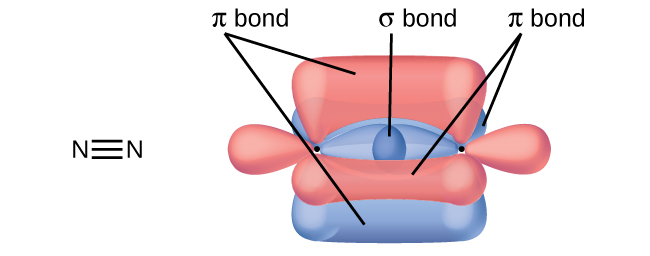
Two nitrogen atoms are shown both in a Lewis structure and as a diagram. The Lewis structure depicts the two nitrogen atoms bonded by a triple bond. The diagram shows two nitrogen atoms and their three peanut-shaped p-orbitals. One of the orbitals lies horizontally and overlaps between the two nuclei. It is labeled, “sigma bond.” The other two lie vertically and in the z-plane of the page. They overlap above and below and into and out of the page in relation to the nuclei. They are each labeled, “pi bond.”Two nitrogen atoms are shown both in a Lewis structure and as a diagram. The Lewis structure depicts the two nitrogen atoms bonded by a triple bond. The diagram shows two nitrogen atoms and their three peanut-shaped p-orbitals. One of the orbitals lies horizontally and overlaps between the two nuclei. It is labeled, “sigma bond.” The other two lie vertically and in the z-plane of the page. They overlap above and below and into and out of the page in relation to the nuclei. They are each labeled, “pi bond.”

5-7 §5.2 source ↗

Why is the concept of hybridization required in valence bond theory?

Answer

Hybridization is introduced to explain the geometry of bonding orbitals in valence bond theory.

5-9 §5.2 source ↗

Explain why a carbon atom cannot form five bonds using sp3d hybrid orbitals.

Answer

There are no d orbitals in the valence shell of carbon.

5-11 §5.2 source ↗

A molecule with the formula AB3 could have one of four different shapes. Give the shape and the hybridization of the central A atom for each.

Answer

trigonal planar, sp2; trigonal pyramidal (one lone pair on A) sp3; T-shaped (two lone pairs on A sp3d, or (three lone pairs on A) sp3d2

5-13 §5.2 source ↗

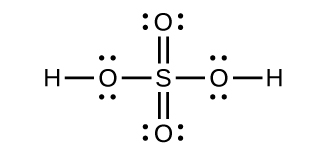
Sulfuric acid is manufactured by a series of reactions represented by the following equations:
S8(s)+ 8O2(g)⟶ 8SO2(g)
2SO2(g)+ O2(g)⟶ 2SO3(g)
SO3(g)+ H2O(l)⟶ H2SO4(l)

Draw a Lewis structure, predict the molecular geometry by VSEPR, and determine the hybridization of sulfur for the following:

(a) circular S8 molecule

(b) SO2 molecule

(c) SO3 molecule

(d) H2SO4 molecule (the hydrogen atoms are bonded to oxygen atoms)

Answer

(a) Each S has a bent (109°) geometry, sp3
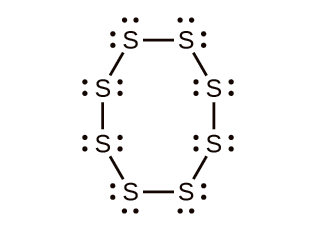
A Lewis structure is shown in which eight sulfur atoms, each with two lone pairs of eletrons, are single bonded together into an eight-sided ring.


(b) Bent (120°), sp2

Two Lewis structure are shown, connected by a double-ended arrow. The left structure shows a sulfur atom with one lone pair of electrons double bonded to an oxygen atom with two lone pairs of electrons on the left and single bonded to an oxygen atom with three lone pairs of electrons on the right. The right structure shows the same molecule, except that the double bonded oxygen is on the right side of the sulfur and the single bonded oxygen is to the left of the sulfur.


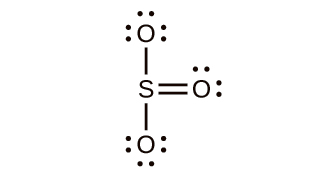
(c) Trigonal planar, sp2

A Lewis structure of a sulfur atom singly bonded to two oxygen atoms, each with three lone pairs of electrons, and double bonded to a third oxygen atom with two lone pairs of electrons is shown.


(d) Tetrahedral, sp3

A Lewis structure is shown in which a sulfur atom is single bonded to four oxygen atoms. Two of the oxygen atoms have three lone pairs of electrons while the other two each have two lone pairs of electrons and are each singly bonded to a hydrogen atom.

5-15 §5.2 source ↗

Analysis of a compound indicates that it contains 77.55% Xe and 22.45% F by mass.

(a) What is the empirical formula for this compound? (Assume this is also the molecular formula in responding to the remaining parts of this exercise).

(b) Write a Lewis structure for the compound.

(c) Predict the shape of the molecules of the compound.

(d) What hybridization is consistent with the shape you predicted?

Answer

(a) XeF2
(b)

A Lewis structure is shown in which a xenon atom that has three lone pairs of electrons is single bonded to two fluorine atoms, each of which has three lone pairs of electrons.


(c) linear (d) sp3d

5-17 §5.2 source ↗

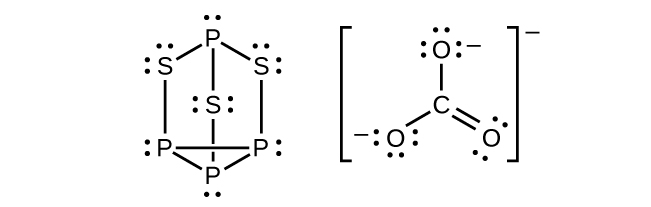
Strike-anywhere matches contain a layer of KClO3 and a layer of P4S3. The heat produced by the friction of striking the match causes these two compounds to react vigorously, which sets fire to the wooden stem of the match. KClO3 contains the ClO3− ion. P4S3 is an unusual molecule with the skeletal structure.
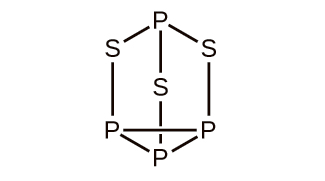
A Lewis structure is shown in which three phosphorus atoms are single bonded together to form a triangle. Each phosphorus is bonded to a sulfur atom by a vertical single bond and each of those sulfur atoms is then bonded to a single phosphorus atom so that a six-sided ring is created with a sulfur in the middle.

(a) Write Lewis structures for P4S3 and the ClO3– ion.

(b) Describe the geometry about the P atoms, the S atom, and the Cl atom in these species.

(c) Assign a hybridization to the P atoms, the S atom, and the Cl atom in these species.

(d) Determine the oxidation states and formal charge of the atoms in P4S3 and the ClO3– ion.

Answer

(a)

Two Lewis structure are shown, the left of which depicts three phosphorus atoms single bonded together to form a triangle. Each phosphorus is bonded to a sulfur atom by a vertical single bond and each of those sulfur atoms is then bonded to a single phosphorus atom so that a six-sided ring is created with a sulfur in the middle. Each sulfur atom in this structure has two lone pairs of electrons while each phosphorus has one lone pair. The second Lewis structure shows a chlorate atom single bonded to two oxygen atoms, each of which has three lone pairs of electrons, and double bonded to an oxygen atom, which has two lone pairs of electrons.


(b) P atoms, trigonal pyramidal; S atoms, bent, with two lone pairs; Cl atoms, trigonal pyramidal; (c) Hybridization about P, S, and Cl is, in all cases, sp3; (d) Oxidation states P +1, S−113, Cl +5, O –2. Formal charges: P 0; S 0; Cl +2: O –1

5-19 §5.2 source ↗

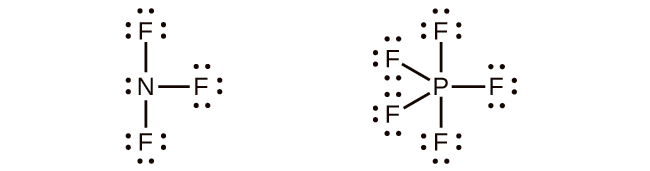
Write Lewis structures for NF3 and PF5. On the basis of hybrid orbitals, explain the fact that NF3, PF3, and PF5 are stable molecules, but NF5 does not exist.

Answer

Two Lewis structures are shown. The left structure shows a nitrogen atom with one lone pair of electrons single bonded to three fluorine atoms, each of which has three lone pairs of electrons. The right structure shows a phosphorus atoms single bonded to five fluorine atoms, each of which has three lone pairs of electrons.

Phosphorus and nitrogen can form sp3 hybrids to form three bonds and hold one lone pair in PF3 and NF3, respectively. However, nitrogen has no valence d orbitals, so it cannot form a set of sp3d hybrid orbitals to bind five fluorine atoms in NF5. Phosphorus has d orbitals and can bind five fluorine atoms with sp3d hybrid orbitals in PF5.

5-21 §5.3 source ↗

The bond energy of a C–C single bond averages 347 kJ mol−1; that of a C≡C triple bond averages 839 kJ mol−1. Explain why the triple bond is not three times as strong as a single bond.

Answer

A triple bond consists of one σ bond and two π bonds. A σ bond is stronger than a π bond due to greater overlap.

5-23 §5.3 source ↗

A useful solvent that will dissolve salts as well as organic compounds is the compound acetonitrile, H3CCN. It is present in paint strippers.

(a) Write the Lewis structure for acetonitrile, and indicate the direction of the dipole moment in the molecule.

(b) Identify the hybrid orbitals used by the carbon atoms in the molecule to form σ bonds.

(c) Describe the atomic orbitals that form the π bonds in the molecule. Note that it is not necessary to hybridize the nitrogen atom.

Answer

(a)

A Lewis structure is shown in which a carbon atom is attached by single bonds to three hydrogen atoms. It is also attached by a single bond to a carbon atom that is triple bonded to a nitrogen atom with one lone electron pair. Below the structure is a right facing arrow with its head near the nitrogen and its tail, which looks like a plus sign, located near the carbon atoms. The arrow is labeled, “dipole moment.”


(b) The terminal carbon atom uses sp3 hybrid orbitals, while the central carbon atom is sp hybridized. (c) Each of the two π bonds is formed by overlap of a 2p orbital on carbon and a nitrogen 2p orbital.

5-25 §5.3 source ↗

Identify the hybridization of the central atom in each of the following molecules and ions that contain multiple bonds:

(a) ClNO (N is the central atom)

(b) CS2

(c) Cl2CO (C is the central atom)

(d) Cl2SO (S is the central atom)

(e) SO2F2 (S is the central atom)

(f) XeO2F2 (Xe is the central atom)

(g) ClOF2+ (Cl is the central atom)

Answer

(a) sp2; (b) sp; (c) sp2; (d) sp3; (e) sp3; (f) sp3d; (g) sp3

5-27 §5.3 source ↗

For each of the following molecules, indicate the hybridization requested and whether or not the electrons will be delocalized:

(a) ozone (O3) central O hybridization

(b) carbon dioxide (CO2) central C hybridization

(c) nitrogen dioxide (NO2) central N hybridization

(d) phosphate ion (PO43−) central P hybridization

Answer

(a) sp2, delocalized; (b) sp, localized; (c) sp2, delocalized; (d) sp3, delocalized

5-29 §5.3 source ↗

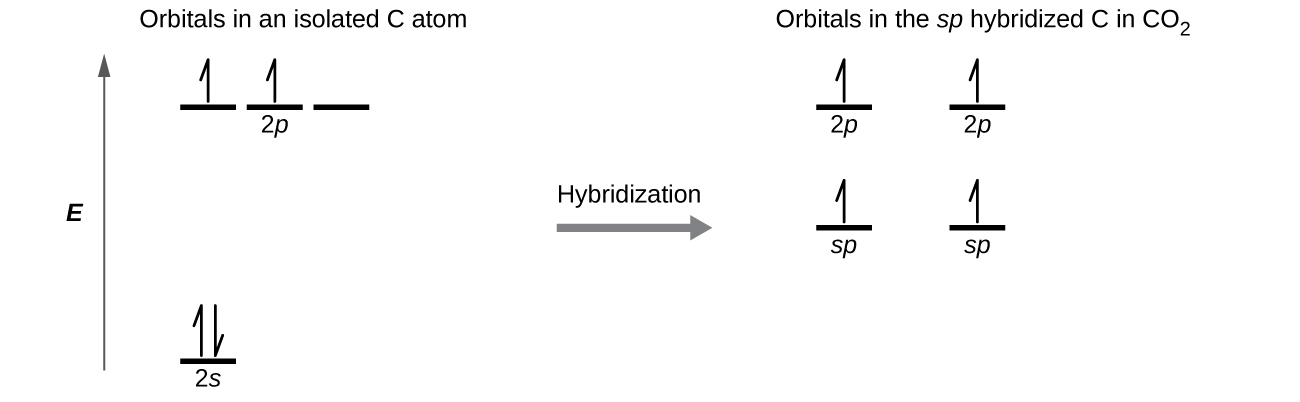
Draw the orbital diagram for carbon in CO2 showing how many carbon atom electrons are in each orbital.

Answer

A diagram is shown in two parts, connected by a right facing arrow labeled, “Hybridization.” The left diagram shows an up-facing arrow labeled, “E.” To the lower right of the arrow is a short, horizontal line labeled, “2 s,” that has two vertical half-arrows facing up and down on it. To the upper right of the arrow are a series of three short, horizontal lines labeled, “2 p.” Above both sets of lines is the phrase, “Orbitals in an isolated C atom.” There are two upward facing arrows on two of these lines. The right side of the diagram shows two short, horizontal lines placed halfway up the space and each labeled, “s p.” An upward-facing half arrow is drawn vertically on each line. Above these lines are two other short, horizontal lines, each labeled, “2 p,” and which have two upward facing arrows on them. Above both sets of lines is the phrase, “Orbitals in the s p hybridized C in C O subscript 2.”A diagram is shown in two parts, connected by a right facing arrow labeled, “Hybridization.” The left diagram shows an up-facing arrow labeled, “E.” To the lower right of the arrow is a short, horizontal line labeled, “2 s,” that has two vertical half-arrows facing up and down on it. To the upper right of the arrow are a series of three short, horizontal lines labeled, “2 p.” Above both sets of lines is the phrase, “Orbitals in an isolated C atom.” There are two upward facing arrows on two of these lines. The right side of the diagram shows two short, horizontal lines placed halfway up the space and each labeled, “s p.” An upward-facing half arrow is drawn vertically on each line. Above these lines are two other short, horizontal lines, each labeled, “2 p,” and which have two upward facing arrows on them. Above both sets of lines is the phrase, “Orbitals in the s p hybridized C in C O subscript 2.”

Each of the four electrons is in a separate orbital and overlaps with an electron on an oxygen atom.

5-31 §5.4 source ↗

How are the following similar, and how do they differ?

(a) σ molecular orbitals and π molecular orbitals

(b) ψ for an atomic orbital and ψ for a molecular orbital

(c) bonding orbitals and antibonding orbitals

Answer

(a) Similarities: Both are bonding orbitals that can contain a maximum of two electrons. Differences: σ orbitals are end-to-end combinations of atomic orbitals, whereas π orbitals are formed by side-by-side overlap of orbitals. (b) Similarities: Both are quantum-mechanical constructs that represent the probability of finding the electron about the atom or the molecule. Differences: ψ for an atomic orbital describes the behavior of only one electron at a time based on the atom. For a molecule, ψ represents a mathematical combination of atomic orbitals. (c) Similarities: Both are orbitals that can contain two electrons. Differences: Bonding orbitals result in holding two or more atoms together. Antibonding orbitals have the effect of destabilizing any bonding that has occurred.

5-33 §5.4 source ↗

Can a molecule with an odd number of electrons ever be diamagnetic? Explain why or why not.

Answer

An odd number of electrons can never be paired, regardless of the arrangement of the molecular orbitals. It will always be paramagnetic.

5-35 §5.4 source ↗

Why are bonding molecular orbitals lower in energy than the parent atomic orbitals?

Answer

Bonding orbitals have electron density in close proximity to more than one nucleus. The interaction between the bonding positively charged nuclei and negatively charged electrons stabilizes the system.

5-37 §5.4 source ↗

Explain why an electron in the bonding molecular orbital in the H2 molecule has a lower energy than an electron in the 1s atomic orbital of either of the separated hydrogen atoms.

Answer

The pairing of the two bonding electrons lowers the energy of the system relative to the energy of the nonbonded electrons.

5-39 §5.4 source ↗

Determine the bond order of each member of the following groups, and determine which member of each group is predicted by the molecular orbital model to have the strongest bond.

(a) H2, H2+, H2−

(b) O2, O22+, O22−

(c) Li2, Be2+, Be2

(d) F2, F2+, F2−

(e) N2, N2+, N2−

Answer

(a) H2 bond order = 1, H2+ bond order = 0.5, H2− bond order = 0.5, strongest bond is H2; (b) O2 bond order = 2, O22+ bond order = 3; O22− bond order = 1, strongest bond is O22+; (c) Li2 bond order = 1, Be2+ bond order = 0.5, Be2 bond order = 0, strongest bond is Li2; (d) F2 bond order = 1, F2+ bond order = 1.5, F2− bond order = 0.5, strongest bond is F2+; (e) N2 bond order = 3, N2+ bond order = 2.5, N2− bond order = 2.5, strongest bond is N2

5-41 §5.4 source ↗

Compare the atomic and molecular orbital diagrams to identify the member of each of the following pairs that has the highest first ionization energy (the most tightly bound electron) in the gas phase:

(a) H and H2

(b) N and N2

(c) O and O2

(d) C and C2

(e) B and B2

Answer

(a) H2; (b) N2; (c) O; (d) C2; (e) B2

5-43 §5.4 source ↗

A friend tells you that the 2s orbital for fluorine starts off at a much lower energy than the 2s orbital for lithium, so the resulting σ2s molecular orbital in F2 is more stable than in Li2. Do you agree?

Answer

Yes, fluorine is a smaller atom than Li, so atoms in the 2s orbital are closer to the nucleus and more stable.

5-45 §5.4 source ↗

What charge would be needed on F2 to generate an ion with a bond order of 2?

Answer

2+

5-47 §5.4 source ↗

Explain why N22+ is diamagnetic, while O24+, which has the same number of valence electrons, is paramagnetic.

Answer

N2 has s-p mixing, so the π orbitals are the last filled in N22+. O2 does not have s-p mixing, so the σp orbital fills before the π orbitals.

Loading chapter 6…

Problems and answers are adapted from Chemistry: Atoms First 2e by Paul Flowers, Edward J. Neth, William R. Robinson, Klaus Theopold and Richard Langley, OpenStax, and are used under the CC BY-NC-SA 4.0 licence. Access for free at https://openstax.org/books/chemistry-atoms-first-2e/pages/1-introduction. Illustrations: Copyright Rice University, OpenStax, under CC BY-NC-SA 4.0 license. This adaptation is released under the same licence, is non-commercial, and is neither affiliated with nor endorsed by OpenStax or Rice University.